There is an ancient Irish teaching that offers a remarkably simple measure by which we might recognize cruelty: the needless tearing of twigs and branches, the needless piling of stones, and the needless disturbance of an animal that has lain down to rest. The simplicity of these three signs is precisely what makes them so powerful. They ask us to consider not merely what harm we are capable of causing, but whether the harm was necessary in the first place. The question is not whether a branch can survive being broken, whether a stone can be moved, or whether an animal can find another place to sleep. The question is why we disturbed them at all.
That distinction matters. Human beings have developed an extraordinary capacity to transform the world around us. We cut forests, quarry mountains, redirect rivers, pave wetlands, move enormous quantities of stone, and construct monuments intended to outlast generations. Sometimes these things are necessary. We need shelter. We need places to live, work, heal, gather, and worship. But necessity and grandeur are not the same thing.
At some point, construction can cease to be about shelter and become an expression of power. We tear living trees from the earth to obtain timber. We quarry mountains and pile stone upon stone to construct buildings whose scale announces the wealth and authority of those who commissioned them. We transform landscapes into monuments to ourselves and then call those monuments sacred. The ancient triad asks us to stop and consider what we have done.
When the Church Becomes the Monument
There is something deeply uncomfortable about the contrast between a towering cathedral and the ethic of the nemeton. Consider the resources required to construct a monumental church: forests harvested for timber, stone extracted from the earth, landscapes altered to accommodate construction, and generations of labor devoted to creating a building that may ultimately serve a relatively small community. Now place that monument beside the teachings attributed to Jesus concerning the poor, the hungry, the homeless, and the stranger.
What does it say when enormous resources are devoted to building houses for God while human beings remain without houses of their own? What does it say when stone is piled toward heaven while people sleep beneath bridges? What does it say when the sacred is enclosed behind walls while the living world outside those walls is treated as expendable?
These questions are not an argument against beauty, craftsmanship, architecture, or gathering places. They are questions about proportion. They ask whether our desire to demonstrate devotion has sometimes become more important than the beings our devotion is supposed to serve.
A cathedral can be beautiful. A cathedral can inspire awe. A cathedral can preserve art, music, history, and community. But beauty does not automatically make an act necessary, and magnificence does not automatically make something holy. If a sacred building requires unnecessary destruction of the living landscape, then the building itself may contradict the ethic it claims to embody.
Sometimes the holiest choice is to refrain from building.
Eden Was Never Lost
Perhaps this is where the old story of Eden deserves to be reconsidered. The familiar interpretation tells us that humanity was cast out of Paradise and that the gates of Eden were thereafter closed to us. Yet the story can also be read as an account of consciousness rather than geography: humanity did not merely lose a garden; humanity lost the ability to recognize where it was.
Later Jewish, Christian, and esoteric traditions developed many interpretations of the figures surrounding Eden. In some later traditions, the archangel Uriel becomes associated with the guardianship of divine mysteries and, in certain esoteric interpretations, with death or the boundary between worlds. The flaming sword itself can be contemplated symbolically as a sword of Forgetfulness: not necessarily a weapon that physically drove humanity away from Paradise, but an image of the veil that prevents us from remembering what was already given to us.
Under this interpretation, the tragedy of Eden is not simply that humanity was expelled from a garden somewhere in the primordial past. It is that we forgot that we were already living in one. Perhaps the gate was never locked. Perhaps the sword was never intended to keep creation away from us. Perhaps it was our own forgetfulness that kept us from seeing.
This possibility resonates strikingly with the Gospel of Thomas, in which Jesus is portrayed as teaching that the Kingdom is already spread throughout the world, yet humanity fails to recognize it. The teaching does not describe Paradise as a distant realm waiting somewhere beyond death. It directs our attention toward the reality immediately surrounding us.
Look again. The Kingdom is here. Eden is here. Creation is here. And what have we done to it?
The Church That God Built
If Eden is not a lost location but a forgotten reality, then perhaps our religious task is not to construct another Paradise. Perhaps our task is to remember the one we already inhabit.
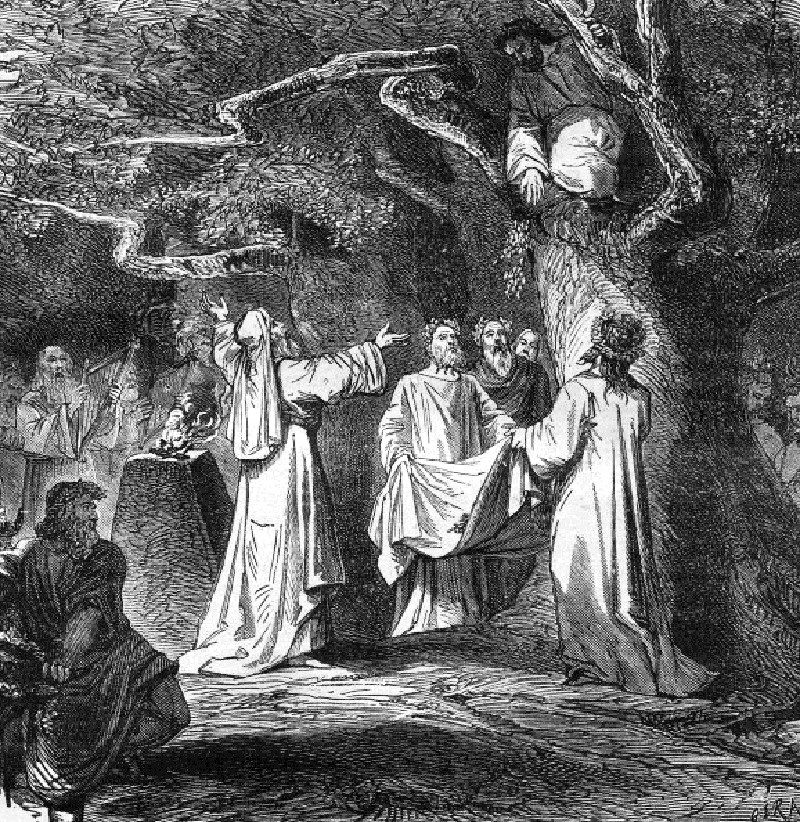
The nemeton offers precisely this possibility. The word nemeton refers to a sacred place or sanctuary, traditionally associated with sacred groves and landscapes. Instead of constructing a building and declaring it sacred, the nemeton begins by recognizing that the landscape is already sacred.
The trees do not need to be removed for God to be present. The stones do not need to be quarried and stacked for the Divine to hear us. The river does not need stained glass beside it to become holy. The mountain does not need a steeple. The forest does not need an altar. Creation itself is the sanctuary.
And this changes the entire relationship between worship and the world. A church asks us to enter a sacred building. A nemeton asks us to recognize that we have never left the sacred.
The distinction is profound. If creation is the work of God, then the living landscape is not merely raw material waiting for human improvement. It is already the handiwork of the Divine. To stand beneath an ancient tree is to stand beneath something we did not create. To kneel beside a river is to kneel beside something no human architect designed. To worship beneath the open sky is to worship beneath the oldest cathedral humanity has ever entered.
The greatest church was built by God’s own hand. It has no walls because the sky is its ceiling. It has no doors because every living creature may enter. It requires no foundation to be quarried because its foundations are the earth itself. Its windows are horizons. Its bells are birdsong, wind, rain, and thunder. Its seasons are its liturgical calendar. Unlike the monuments we construct, it does not require us to destroy one part of creation in order to make another part sacred.
The Nemeton and the Three Signs of Cruelty
This is where the ancient triad becomes particularly powerful. Needlessly tearing branches is not merely an act of physical destruction. It represents the assumption that the living world exists for our convenience. Needlessly piling stones represents another expression of the same impulse: taking the substance of the earth, rearranging it according to our will, and assuming that our purposes are more important than the landscape we inherited. Needlessly disturbing an animal at rest completes the picture. Here the victim is not a resource at all. The animal has done nothing except exist and seek a place of rest, yet even that existence becomes something we feel entitled to interrupt.
Together, these three acts describe a particular human attitude: I may alter the world simply because I can. That attitude is the opposite of reverence. Reverence asks, “Must I?” Cruelty asks only, “Can I?”
The nemeton answers with restraint. It teaches us that holiness can sometimes mean leaving something exactly where we found it. This is why the ancient triad is more than a list of minor offenses. It can be understood as a spiritual discipline for an age of extraordinary human power. It asks us to develop the capacity to refrain from interfering merely because interference is possible.
The lesson is astonishingly modern. We possess the technological power to move mountains, redirect rivers, clear forests, reshape coastlines, and transform entire ecosystems. The question before us is no longer simply what humanity can accomplish. It is whether humanity has learned when it should not.
From Forgetfulness to Extinction
The consequences of forgetting this lesson are no longer theoretical. Human beings have transformed the planet on a scale unprecedented in our history. Habitat destruction, overexploitation, pollution, invasive species, and climate change have placed enormous pressure upon the living world. Species have disappeared, ecosystems have been fragmented, and relationships between organisms that took millions of years to develop have been disrupted within a handful of human generations.
A branch broken needlessly may seem insignificant. A stone moved unnecessarily may seem insignificant. An animal disturbed from its resting place may seem insignificant. But the mentality behind those acts can become catastrophic when multiplied across civilizations.
A forest does not disappear because someone breaks one branch. It disappears when millions of decisions are made according to the assumption that every tree is ours to take. A species does not necessarily vanish because one person disturbed one animal. Populations collapse when generations of human activity continually remove habitat, food, shelter, breeding grounds, and ecological stability.
The ancient teaching therefore reaches far beyond the individual acts it describes. It asks us to recognize the mentality of unnecessary interference before that mentality becomes destruction on a scale that cannot be repaired. Some species have already disappeared. We cannot worship them back into existence. We cannot build a cathedral large enough to compensate for an ecosystem we have destroyed. We cannot pile enough stones to replace a forest. We cannot write enough prayers to resurrect a species that no longer has a habitat in which to live.
But we can remember. And remembering can change what we do next.
A Different Kind of Church
The nemeton provides an alternative vision of religious architecture because it does not begin with architecture at all. It begins with relationship.
The sacred grove does not proclaim human mastery over nature. It requires humility before something older and greater than ourselves. It asks the worshipper to enter the landscape as a guest rather than an owner.
This is particularly important in an age in which humanity possesses unprecedented technological power. Our ability to alter the world has grown enormously. Our wisdom has not necessarily grown at the same pace.
Perhaps the next great development in spirituality should therefore not be another monument, another tower, or another magnificent house of worship. Perhaps it should be restraint. Perhaps holiness should once again include the courage to leave things alone.
Let the forest remain a forest. Let the stone remain where the earth placed it. Let the animal sleep. Let the river run. Let the meadow grow. Let the mountain stand. And when we need a place to worship, let us go outside.
From Monument to Restoration
The nemeton need not merely prevent further destruction. It can become an instrument of restoration. A sacred landscape can be planted where a forest was cleared. Native species can be returned to damaged ground. Wetlands can be restored. Pollinator gardens can replace sterile lawns. Streams can be cleaned. Habitat can be protected rather than developed.
A church building can consume resources. A sacred landscape can restore them. A cathedral can commemorate creation. A nemeton can participate in its healing.
This does not mean that every existing church should be demolished or that every building is inherently an act of ecological violence. Buildings can be repurposed, restored, made efficient, and used to shelter communities. The question is not whether humanity should ever build. The question is whether we have forgotten the difference between what we need and what our egos desire.
The answer does not have to be destruction. It can be transformation. Perhaps some churches could become community shelters, food banks, schools, clinics, cultural centers, or houses of hospitality. Perhaps their surrounding grounds could become gardens, habitats, and places of ecological restoration. Perhaps the building can become a servant rather than a monument.
The sacred does not require us to destroy what already lives.
The Nemeton as Remembering
Perhaps, then, the deepest purpose of the nemeton is not to create a sacred place but to restore our ability to perceive the sacredness of place.
The human ego says, “This is merely a forest.” The nemeton says, “Look again.” The ego says, “This is merely a stone.” The nemeton says, “Look again.” The ego says, “This is merely an animal.” The nemeton says, “Look again.”
And perhaps the greatest spiritual practice is precisely this act of looking again.
The world has not become less sacred because we have forgotten. Eden did not disappear because humanity stopped recognizing it. The Kingdom did not cease to surround us because we stopped seeing it. Creation did not become ordinary. We became accustomed to it.
We became so familiar with the miracle that we mistook familiarity for mundanity.
The nemeton interrupts that forgetfulness. It asks us to step outside the walls we have constructed, both physical and spiritual, and encounter the world again as though we have never seen it before.
A Church Without Walls
The nemeton offers a vision of worship in which the boundary between sanctuary and creation disappears. There is no need to leave the natural world in order to find God because the natural world is already within God. There is no need to construct a monument to remind us of the Creator when creation surrounds us at every moment. There is no need to make the earth holy.
It already is.
Our task is to become humble enough to recognize it.
This is why the nemeton is more than a physical place. It is an ethic. It is a discipline of restraint. It is a refusal to treat existence as raw material for human ambition. It is the recognition that the world does not exist merely to serve us. It is the humility to understand that we are participants in creation, not its owners.
And perhaps this is one of the most important lessons the ancient triad can offer the modern world: before asking what we can build, we should ask what we can preserve. Before moving the stone, ask whether it needs to be moved. Before breaking the branch, ask whether it needs to be broken. Before disturbing the creature at rest, ask whether we have any right to disturb it. Before building another monument to ourselves, look around.
Look again.
The garden is still here. The Kingdom is still here. The Sacred has never left. We simply forgot how to see it.
The greatest church may already be standing.
It is called Creation.
And it was built by God.


Leave a Reply