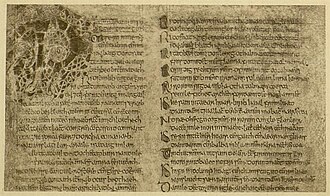
The Saltair na Rann (“Psalter of the Verses”) stands among the great literary and devotional treasures of medieval Ireland. Composed in the tenth century and traditionally attributed to the poet-scholar Óengus Céile Dé, the work consists of more than one hundred and fifty poems organized into hundreds of carefully structured stanzas. Though inspired by the devotional spirit of the Biblical Psalms, the Saltair na Rann is not merely a translation of Scripture. Rather, it is a poetic retelling of sacred history through the voice, imagination, and literary artistry of the Gaelic world.
Like many of the finest works of Celtic Christianity, the Saltair na Rann demonstrates that the Irish did not abandon their cultural inheritance upon embracing the Christian faith. Instead, they sought to express Christian truths through the forms of language, poetry, and symbolism inherited from their ancestors. The result is a work that is simultaneously Biblical and Gaelic, universal and local, Christian and distinctly Irish.
A Poetic History of Creation and Salvation
The Saltair na Rann begins at the beginning.
Drawing upon Scripture, the poems recount the creation of the world, the fall of humanity, the story of Noah and the Flood, the patriarchs, the kings of Israel, and many of the great events of sacred history. Yet these narratives are not presented as dry chronicles. They are transformed into living poetry, intended not only to educate but also to inspire devotion and contemplation.
The poet invites his audience to see themselves as participants in the unfolding drama of creation and redemption. Biblical history becomes more than a distant record of foreign peoples and faraway lands; it becomes the shared inheritance of all Christian nations, including the Gaels.
Like the Lebor Gabála Érenn, the Saltair na Rann seeks to place Ireland within the broader framework of sacred history. The same God who guided Israel through the wilderness and spoke through the prophets is also the God worshipped in the churches, monasteries, and sacred landscapes of Ireland.
Poetry as Prayer
One of the most remarkable features of the Saltair na Rann is its poetic form. The work employs native Irish meters, alliteration, and rhythmic structures developed over centuries by Gaelic poets and bards.
In this respect, the Saltair reveals something profound about early Irish Christianity. The faith was not simply translated into the Irish language; it was incarnated within Irish culture. The skills once used to preserve genealogies, heroic tales, and ancestral lore were now employed to recount the deeds of God and the history of salvation.
For medieval Irish Christians, poetry was not merely an art form. It was a means of preserving wisdom, transmitting memory, and lifting the soul toward divine realities. The Saltair na Rann stands as a testament to this sacred vocation of the poet.
Creation as a Reflection of Divine Glory
Throughout the work, creation itself is treated with reverence and wonder. The heavens, the earth, the sea, the stars, and the cycles of nature are described as manifestations of divine wisdom and power.
This emphasis resonates deeply with themes found throughout Celtic Christianity. While firmly grounded in Biblical theology, the Saltair na Rann reflects a spirituality that sees the natural world as a revelation of God’s presence. Creation is neither separate from the spiritual life nor merely a backdrop to it. Rather, it becomes a living testament to the Creator.
Such themes often remind modern readers of older Gaelic attitudes toward the land, the seasons, and the sacredness of place. The Saltair demonstrates how these sensibilities found renewed expression within a Christian framework, becoming part of a uniquely Celtic vision of creation.
The Voice of the Céile Dé
The Saltair na Rann emerged during a period of spiritual renewal associated with the Céile Dé (“Servants of God”), known in Latin as the Culdees. These reforming ascetics emphasized prayer, learning, simplicity, and devotion.
Their spirituality sought not only intellectual understanding but also transformation of the heart. The poems of the Saltair reflect this spirit. They invite the reader to meditate upon the mysteries of creation, the consequences of sin, the mercy of God, and the hope of redemption.
For this reason, the text functions not merely as literature but as a devotional guide. It was intended to shape the inner life of the believer and cultivate a continual awareness of God’s presence.
Why It Matters Today
For modern Gaels, the Saltair na Rann offers a glimpse into a period when Christianity and Gaelic culture existed in profound harmony. It reveals a tradition that was neither wholly Roman nor wholly indigenous, but a creative synthesis of both.
The work reminds us that faith does not require the abandonment of language, heritage, or cultural memory. Rather, these things can become vessels through which spiritual truths are expressed and transmitted.
For Celtic Christians, the Saltair provides a distinctly Gaelic meditation upon the great themes of Scripture. For Druids and students of Celtic spirituality, it offers insight into how ancestral poetic forms continued to shape the religious imagination of Ireland long after the coming of Christianity. For all readers, it stands as a monument to the power of poetry to preserve wisdom, inspire devotion, and unite a people with their sacred history.
In this sense, the Saltair na Rann serves as a companion to the Biblical narrative, not replacing Scripture but illuminating it through the language, imagination, and spiritual sensibilities of the Gaelic world. It remains one of the clearest expressions of the uniquely Celtic voice that emerged within the wider Christian tradition—a voice rooted in memory, reverence, and wonder before the mystery of God and creation.
 ArdNemeton na Tuatha
Leave a comment