A.D. Brock Adams
When Christianity arrived on Irish shores, it did not land in an empty spiritual landscape. It encountered a culture ancient in its devotions, rich in its reverence for ancestors and the sacred powers of place, and sophisticated in its understanding of the divine as something woven into the living world. What followed was not conquest but conversation — a gradual, often creative process of synthesis in which old forms were not destroyed but reborn, and ancient figures were not discarded but transfigured. The veneration of saints in early Irish Christianity is perhaps the most visible and enduring expression of that process.
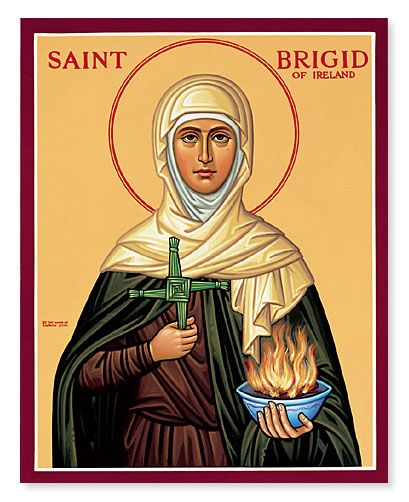
St. Brigid: The Flame That Never Went Out
No figure better embodies this synthesis than Brigid — at once a goddess of the Tuatha Dé Danann and one of Ireland’s three patron saints. The goddess Brigid was associated with spring, fire, fertility, healing, and poetry — attributes almost identical to those of Saint Brigid of Kildare. The continuity between them was not accidental. The goddess Brigid was syncretized with Saint Brigid in a process whereby the practices, beliefs, and traditions of a Christian saint were merged and blended with an earlier, often mythological figure.
This blending was enacted not merely in theology but in the landscape itself. Kildare, the site of her monastery, was already sacred to the goddess Brigid. There, nuns tended a perpetual flame, echoing earlier fire cults. Her feast day, February 1st, coincides exactly with Imbolc — the ancient festival marking the first breath of spring — suggesting deliberate syncretism. Customs such as the making of Brigid’s crosses — woven from rushes and hung above doorways to protect homes from fire, famine, and misfortune — have roots in pre-Christian seasonal ritual.
Christianity came to Ireland not at the point of a sword but by persuasion and habit, and that makes a profound difference when it comes to syncretism. In a culture never militarily conquered by Rome, the old traditions were not forcibly suppressed — they were invited into conversation with the new, and the result was something neither purely Druidic nor purely Roman, but distinctly and irreducibly Irish.
Other Figures of the Threshold
Brigid was not alone in embodying this convergence. A number of early Irish saints carry within their hagiographies the unmistakable traces of pre-Christian sacred authority, as if the ancient archetypal roles — healer, keeper of sacred fire, guardian of the threshold between worlds — were simply transferred from one framework into another rather than abandoned.
Ciarán of Saigir is traditionally considered the first saint born in Ireland and is said to have preceded Saint Patrick — a claim that places him in a liminal zone between the old world and the new. Whether this tradition is historically precise or legendary, it signals a conscious cultural memory: that Christianity in Ireland had roots older than the Roman mission, growing from soil already prepared by generations of indigenous spiritual practice.
St. Columba, the great founder of Iona and one of the most powerful monastic figures of the sixth century, similarly stands at this threshold. Adomnán’s Life of Columba provides extensive references to reading, writing, and scribal culture at Iona, presenting Columba as both a Christian abbot and a keeper of the bardic traditions of memory and transmission that had long defined the role of the Druidic filidh. The scholar-saint who illuminated manuscripts was, in many respects, the Christian successor to the poet-priest who had held the tribe’s memory.
St. Aengus the Culdee — the Céile Dé — represents perhaps the most self-conscious expression of this synthesis. As both ascetic Christian and heir to the intellectual traditions of the old bardic schools, Aengus embodied the Celi-De conviction that the deepest currents of Irish spiritual life need not be abandoned but purified and carried forward. His life stands as both testimony and programme: a demonstration that the spiritual inheritance of pre-Christian Ireland could find new expression within the Christian framework without being uprooted from its native ground.
The Texts of Synthesis
This spirit of creative convergence left its mark in the great textual monuments of early Irish Christianity.
The Saltair na Rann — the Psalter of Quatrains — is among the most remarkable. Structured in 150 cantos in deliberate imitation of the Psalms of David, it may justly be regarded as the Irish Paradise Lost and Paradise Regained: opening with the creation of the universe, the fall of Lucifer, and the making of the earthly paradise, it narrates sacred history through to the death and resurrection of Christ. Yet for all its biblical architecture, it is peculiarly Irish in tone, and its additions and variations are of the greatest interest — its conception of the universe, with its seven heavens, coloured and fettered winds, and the sun passing through the opening windows of the sky, reflects a cosmological imagination shaped as much by native tradition as by scripture. Significantly, the author of one of its devotional poems identifies himself as Óengus Céile Dé — linking the great mythological-biblical poem directly to the Celi-De movement and its project of holding the two worlds together.
The Stowe Missal, compiled most likely at Tallaght Monastery around 792–812 CE, offers a parallel witness in liturgical form. The version of the Mass it preserves is thought to be older than the manuscript itself, reflecting early Celtic Christian usage. Alongside its liturgical contents, the Missal includes an Irish tract on the Mass and three Irish spells — against loss of eyesight, injury by thorns, and disease — evidence that the boundary between formal liturgy and older healing tradition remained permeable well into the Christian period. The theology of the Stowe Missal reflects the particular concerns of the Celi-De movement flourishing around Tallaght at the time of its composition — a theology rooted in penitential devotion, ascetic discipline, and the integration of indigenous spiritual wisdom within a Christian framework.
The Red Hem: A Symbol of Transformation
Among the subtler and more intriguing symbols of this convergence is the red trimming on ecclesiastical robes — a detail that carries layered meaning across both traditions. In the older Druidic hierarchy, a red-trimmed robe signalled a priest given to martial tendencies, a figure whose warlike inclinations placed them at odds with the Druid’s fundamental vocation of peace, wisdom, and the preservation of social harmony. Such a figure was to be regarded with caution, even shunned.
When the Culdees — the Céile Dé, the companions of God — incorporated this emblem into their own practice, they did not erase its meaning but transformed it. The red trim became a reminder rather than a mark of honour: a visible caution sewn into the garment itself, urging the bishop who wore it to resist the temptations of power and violence and to embody instead the peaceable, spiritually grounded leadership that had once been the hallmark of the wise Druid. The blood-red that had once evoked the fallen was recast as the blood of the Risen — a symbol of sacrifice transfigured into compassion, of power laid down in service.
It is a small detail, but it speaks volumes about how this tradition worked: not by erasure, but by reinterpretation; not by forgetting, but by remembering in a new key.
The Unbroken Thread
What the veneration of saints in early Irish Christianity ultimately reveals is a tradition that refused to regard its own past as a problem to be solved. The ancient sacred figures — the goddesses, the tribal guardians, the wise ones of the grove — were not demons to be cast out. They were ancestors to be honoured, archetypes to be transfigured, and vessels through which the sacred knowledge of generations could be carried forward into new forms.
Whether as a member of the Tuatha Dé Danann or as the Mary of the Gael, Brigid remains a symbol of healing, poetry, and the enduring power of the land itself — a figure who illustrates how a people can reshape their sacred world without fully abandoning the old.
In this, the early Irish church was not departing from its Druidic inheritance. It was, in the deepest sense, continuing it.
References
- Adomnán (7th–8th c.). Vita Sancti Columbae [Life of Columba].
- Carey, J. (1999). The Celtic Christian Church: Origins and Practices. Four Courts Press.
- Duffy, P. (1997). Saints and Scholars: Essays on Irish Religion. Four Courts Press.
- Ó Cróinín, D. (1995). Early Medieval Ireland, 400–1200. Longman.
- O’Loughlin, T. (2000). Celtic Theology: Humanity, World, and God in Early Irish Writings. Continuum.
- Sharpe, R. (1991). Medieval Irish Saints’ Lives. Oxford University Press.
- Warner, G.F., ed. (1906, 1915). The Stowe Missal, 2 vols. London.
 ArdNemeton na Tuatha
Leave a comment