A.D. Brock Adams
Introduction: The Sacred Table
Every tradition that takes the body seriously has developed a theology of food. The Jewish kashrut, the Islamic halal, the Hindu dietary observances, the Pythagorean abstentions — each is an expression of the same underlying conviction: that what we eat, how we kill, how we prepare, and how we share is not merely a matter of nutrition or custom but of sacred alignment. The body that consumes participates in what it consuming. The act of eating is an act of covenant.
Ghlan Naoimh — Holy Purity — is the Gaelic expression of this universal sacred principle. It is the tradition’s own theology of sanctified offering: an ethical code governing the preparation, consumption, and blessing of food, rooted in the Celtic sacrificial tradition, transformed by the Christian understanding of the Eucharist, and expressed in a set of living practices that bridge the ancient and the contemporary in the same way the tradition has always bridged what others have kept apart.
The Haruspex and the Gutuatri: Priests of Discernment
The tradition of the Haruspex originated within Etruscan religion and was integrated into Roman state ritual as a form of divinatory priesthood — a ritual specialist responsible for ensuring the purity of sacrificial practice and the moral alignment of human action with divine order. His function blended theology, ethics, and governance: the same synthesis that characterised the Druidic order in its fullest expression.
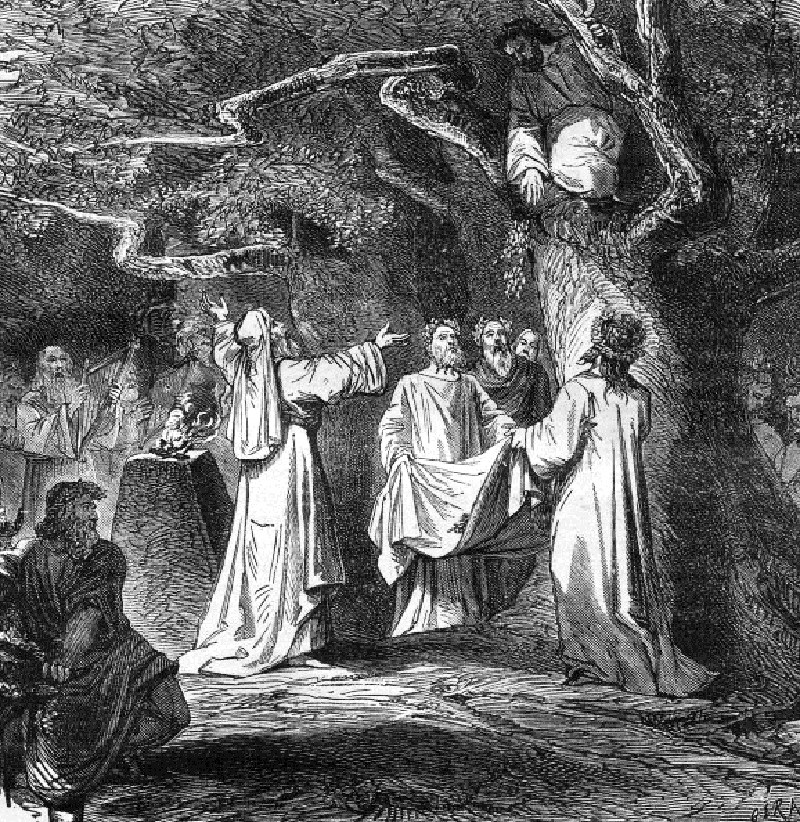
In the Celtic world, the closest institutional parallel was the Gutuatri — from the Gaulish gutuatros, meaning one who calls upon the divine or invoker. Alongside the Druids as judges and philosophers, and the Bards as preservers of oral tradition, the Gutuatri functioned as ritual performers and masters of sacrifice — the hands-on priestly specialists of the Gaulish religious order. Where the Druid deliberated and the Bard transmitted, the Gutuatri officiated — standing at the altar, managing the sacrifice, enacting the covenant between the community and the divine powers it was seeking to address.
Their divinatory practice was characteristically Celtic in form. Rather than relying exclusively on the entrails of sacrificial animals as the Roman Haruspex did, Gutuatric divination drew upon the observation of natural phenomena — the flight of birds, the direction of wind, the behaviour of animals — alongside the interpretive systems of the bardic tradition, including Ogham. Pliny described the Vates, closely related to the Gutuatri, as interpreters of sacrifice — those who read the sacred meaning of the offering and communicated it to the community.
The Gutuatric rite was dialogical rather than authoritarian. Divination served as the prelude to communal feasting, where the act of consuming the sacrificial meal confirmed the participants’ assent to the oracle’s meaning. To eat of the offering was to affirm its binding truth; to abstain was to withhold consent. The sacrifice was covenantal — a pact between humanity and divinity enacted through food, community, and the freely given consent of all who shared the table.
Sacrifice in the Celtic Context: Transformation, Not Violence
The sacrificial practices of the Celtic world must be understood within their own theological framework. They were deeply tied to kingship, fertility, and the maintenance of cosmic balance — the understanding that the sacred order of the world requires active maintenance, and that the community’s relationship with the divine powers sustaining it must be regularly renewed through deliberate act.
The Tarbh Feis — the Bull Feast — was a central rite of Irish kingship. A bull was killed and a chosen seer, sometimes a Druid or Bard, would eat his fill of the flesh and drink the broth, then lie down wrapped in the bull’s raw hide while four Druids chanted a truth spell over him. In his sleep he would see the face of the true king. The sleeper would perish if he uttered a falsehood. The white bull was taken to a high place at Lughnasadh and sacrificed — the ritual binding divination, sacrifice, and the legitimation of sovereignty into a single act.
The sacrifice was not an act of violence in the modern sense. It was an act of transformation — the offering of strength and fertility back to the powers from whom those qualities ultimately came, in the expectation of their renewal. The king’s legitimacy was grounded in his covenant with the land and its divine powers, enacted through the sacrificial rite. The king had great power but also great responsibility — through his inauguration he was married to the goddess of the land, and was personally responsible for ensuring her benevolence. If the weather turned bad, if there was plague or cattle disease, the king was held accountable.
Archaeological evidence from bog bodies such as Old Croghan Man — found at the foot of an ancient hill used for kingship ceremonies — suggests that in extreme circumstances, when the covenant between king and land was understood to have broken down catastrophically, the king himself could become the sacrifice. The tradition of ArdNemeton does not practise or advocate any form of human sacrifice. It honours the theological principle underlying the ancient rite — that the sacred order demands real commitment and real accountability — while understanding that this principle has been fulfilled and transformed once and for all by the Incarnation and the sacrifice of Christ.
The Eucharist as the Fulfillment of Human Sacrifice
The most significant theological transition in the Celtic world’s encounter with Christianity was the understanding that the Incarnation and Passion of Christ brought the era of human sacrifice to its permanent and irreversible close. This was not experienced by the early Gaelic Church as an imposition from without but as a recognition from within: that what the tradition had always understood as the ultimate offering — the giving of sovereign life for the renewal of the sacred covenant — had been accomplished once, completely, and perfectly in the person of Christ, making all subsequent human offerings not merely unnecessary but theologically redundant.
Christ did not come to abolish the sacrificial principle. He came to fulfill it. The one perfect human sacrifice, freely given, accepted by God, and vindicated in the Resurrection, becomes the permanent foundation of the tradition’s covenant with the divine. Every Eucharist celebrated in the grove, in the monastic enclosure, or in the open air of the sacred landscape is the memorial and living participation in that single act — the community gathering around the table to receive again the fruit of the offering that ended all others of its kind.
The early Gaelic sources understood this with a clarity that was distinctly their own. Christ’s death was the final iobairt mór — the Great Offering — after which the Mass stands as the ongoing covenant meal: the communal feast through which the community continually renews its relationship with the divine life offered in Christ. The ancient pattern of sacrifice, feast, and covenantal renewal is not abandoned. It is given its permanent and complete form.
The Triple Death and the Soul’s Passage
While the Eucharist replaces human sacrifice as the tradition’s central act of covenantal offering, the animals that fuel the sacred feast require their own theological care — and here the tradition preserves one of its most distinctive and theologically serious practices.
In Gaelic and broader Celtic tradition, the concept of the triple death — a ritual killing that employs three different methods simultaneously — carries profound spiritual significance. The bog body evidence suggests that ritual killings in the Celtic world were frequently excessive in precisely this sense: multiple methods applied to a single death, more than mere killing requires. This was not cruelty. It was a specific ritual logic: by subjecting the offered life to the triple death, the presiding priest confuses Ankou — the spirit of death, the great harvester who stands at the threshold between this life and the next — into releasing the soul for immediate rebirth rather than retaining it in the liminal state between lives.
Ankou, in the Gaelic and Breton understanding, is the guardian of death’s threshold: the one who comes for souls when their time has come, the great leveller who does not distinguish between king and commoner. He recognises death by its signature — the particular mark that a single cause of dying leaves upon a soul. The triple death confounds that signature. By dying by earth, by water, and by fire — by blade, by immersion, and by the sacred fire — simultaneously, the offered creature presents a death that Ankou cannot categorise, a soul whose passage he cannot halt in the ordinary way.
The theological purpose of this confusion is compassionate rather than manipulative. The animal offered in the sacred feast has given its life in an act of genuine sacrifice — participating, in its own degree, in the same sacrificial logic that underlies the Eucharist itself. For this reason, the tradition holds that such an animal, honoured in its offering and given the triple death, advances in its next incarnation to the human stage of development within the Barddas cosmology of Abred — the world of becoming in which all souls progress through the levels of experience toward the fullness of Saoirse. The beast that dies for the feast is not merely consumed. It is advanced. Its sacrifice is its graduation.
This is a theology of sacred reciprocity: the community that benefits from the animal’s offering owes it the greatest gift the tradition can give — the assurance of its soul’s progress. The priest who oversees the killing bears this responsibility personally. To kill without the triple death is to abandon the offered creature to an uncertain passage. To kill with it is to honour the offering in the fullest sense the tradition knows.
The Feast as Covenant: Lordship and Reciprocity
The communal feast in the Gaelic tradition was never the private property of those who convened it. It was a public act of covenant — and its convening was, under the Brehon legal understanding, a primary obligation of leadership.
The lord who fed his people demonstrated his fitness to lead them. The feast was governance made visible: a ruler who fed the folk demonstrated their fitness to steward land, law, and peace. This principle ran as deep as the tradition itself. Under Brehon law, the briugu — the hospitaller — was legally bound to feed every stranger who came to their door, regardless of status or numbers. For those of higher standing the obligation was proportionally greater. The lord who held territory, who collected tribute, who profited from the labour and loyalty of the community beneath him, was bound by the same sacred reciprocity to return that benefit in the form of the feast.
This is not generosity in the modern sense of a voluntary act of kindness performed from surplus. It is structural obligation — woven into the legal definition of what lordship means. To hold power over a community is to accept the responsibility of feeding that community. The feast is the visible proof that the relationship between the ruling party and the people they rule is genuinely mutual: that the lord receives from the community and gives back to it in kind, that the covenant flows in both directions, that power is held in trust rather than owned.
Any lord who refuses to fuel the feast loses the legitimacy of their lordship. This is not metaphor. Under the Brehon system, a chief whose table was bare, whose feast was cancelled, whose community went unfed at the appointed times, had already failed in the most fundamental expression of their office. Their honour-price fell. Their authority was forfeited not by formal deposition but by the community’s recognition that the covenant had been broken from above.
The tradition of ArdNemeton upholds this principle without qualification. Those who hold office — whether spiritual, civic, or communal — hold it in trust for the community they serve. The feast is their covenant renewed in public, season by season, at every appointed turning of the sacred year. Its absence is a statement about the quality of their leadership that no amount of words can undo.
Ghlan Naoimh: The Three Principles
Ghlan Naoimh — Holy Purity — establishes an ethical code governing the preparation, consumption, and blessing of food within the tradition of ArdNemeton. It is grounded in three core principles:
Reverence for Life. No creature is killed without acknowledgement of its spirit and gratitude for its offering. The animal that gives its life for the nourishment of the community is understood as participating in the same sacrificial logic that underlies the Eucharist. It is honoured as a sacred offering — its death performed with the triple death so that Ankou is confounded, its soul guaranteed its passage to the next stage of development in Abred, its sacrifice received with the full weight of theological seriousness it deserves.
Purity of Action. Every act of preparation — from the raising of the animal to the slaughter, the harvest to the cooking — is undertaken with ritual cleanliness, sobriety, and prayer, in accordance with the Brehon food customs of the tradition. The sanctity of the meal is not created at the table. It is maintained through the entire chain of actions that brings food to the table. The Christo-Druidic Haruspex bears responsibility for this chain — not only for the moment of blessing but for the integrity of the process that precedes it.
Communal Sanctity. Food is shared as covenant. Meals are accompanied by thanksgiving, by reconciliation among participants, and by the obligation that nothing be wasted. The feast is the visible expression of the community’s covenant with the divine and with one another — and it is the obligation of those who hold authority within the community to ensure that it takes place, that it is sufficient, and that no member of the community is excluded from nourishment or dignity. The lord who fails this obligation has already failed their lordship.
The Modern Haruspex: Priest of Discernment and Steward of the Covenant
The contemporary Christo-Druidic Haruspex carries forward the ethical burden of the ancient priestly office while interpreting it through the light of Christ. His divination no longer involves the reading of entrails but the discernment of signs in conscience, in prayer, in the quality of the community’s life together, and in the state of the sacred landscape he is called to steward. His sacrifice is not one of death but of humility, gratitude, and service.
He oversees the triple death of the animals offered for the feast, taking personal responsibility for the soul’s passage that his office guarantees. He ensures that the preparation is pure, the feast is convened, the lord has fulfilled their obligation, the vulnerable have been fed, and nothing has been wasted. He blesses the table and leads the thanksgiving.
To practice Ghlan Naoimh is to live sacramentally: to treat all food, all labour, and all life as consecrated. The table becomes the altar. The meal becomes the Eucharist extended into the dailiness of existence. The ancient covenant between the community, its leaders, its animals, its land, and its God is renewed at every properly convened feast — season by season, year by year, generation by generation — as it has always been renewed, and as it must always be renewed, by those who understand what the table is for.
References
- Caesar, Julius. De Bello Gallico, Book VI.
- Pliny the Elder. Historia Naturalis, Book XI.
- The Destruction of Dá Derga’s Hostel, trans. Whitley Stokes (1901).
- Kelly, Eamonn. ‘Kingship and Sacrifice: Iron Age Bog Bodies in Ireland’. National Museum of Ireland.
- Kelly, Fergus (1988). A Guide to Early Irish Law. Dublin Institute for Advanced Studies.
- MacCana, Proinsias (1970). Celtic Mythology. Hamlyn.
- Carmichael, Alexander (1900). Carmina Gadelica. T. & T. Clark.


Leave a Reply