A.D. Brock Adams
A Name From Outside
The word Celt was never what the people called themselves.
This is the first and most important thing to understand about the term — and understanding it changes everything about how it is used. Keltoi is a Greek word, applied from outside to a constellation of peoples the Greek world encountered at its western and northern edges. It passed into Latin as Celtae, was used by Caesar as a convenient administrative category for the peoples of Gaul, and has accumulated layers of meaning, misuse, romantic projection, and genuine scholarly insight across the millennia since.
What it has never been is an ethnic designation in the modern sense. Celtic and La Tène were in no way ethnic designations. Instead, these were influential and far-reaching cultures, adopted by many different ethnic groups connected through trade and shared borders. The diverse Celtic languages could have acted as the lingua franca of the time, while many European Iron Age tribes and ethnicities all spoke their own languages.
To be Celt is to participate in a cultural and linguistic continuum — not to belong to a bloodline, not to carry a genetic marker, not to be the exclusive property of any one island or peninsula. The Celts were, from the beginning, a phenomenon of relationship: shared language, shared material culture, shared sacred practice, shared aesthetic sensibility, spreading through trade and migration and the movement of ideas rather than through conquest or ethnic exclusivity.
The La Tène Horizon
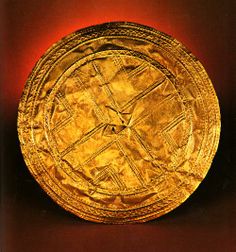
The archaeological signature most commonly associated with Celtic cultural identity is the La Tène culture, named after its type site on the northern shore of Lake Neuchâtel in Switzerland. La Tène culture originated in the mid-fifth century BCE, when the Celts came into contact with Greek and Etruscan influences from south of the Alps. This culture passed through several phases and regional variations during the next four centuries as the Celts expanded throughout most of northern Europe and the British Isles.
Artefacts of the La Tène culture have been discovered in a wide arc covering western and central Europe, spanning from Ireland to Romania. The site itself — discovered in 1857 when prolonged drought lowered the waters of Lake Neuchâtel, revealing the timbers of an ancient bridge and the weapons and votive offerings deposited around it — gave archaeologists a name for one of the most significant cultural horizons of the Iron Age. The people of the La Tène culture dedicated offerings of precious goods to their gods, frequently by throwing them in water — in this case, Lake Neuchâtel — in a practice that echoes across later Celtic cultures in Britain and Ireland.
What the La Tène horizon represents is not a single people marching out of Switzerland but a cultural wave — a shared aesthetic, technological, and spiritual sensibility that spread through the mechanisms of trade, marriage, migration, and the movement of skilled craftsmen. The intricate spiral metalwork, the sophisticated ironworking, the warrior aristocracy, the Druidic religious institutions, the fondness for votive deposits at sacred water sites — these appear across a vast geographic range not because one tribe conquered everyone else, but because a cultural idea was compelling enough to be adopted, adapted, and developed by many different peoples in many different landscapes.
Caesar’s Lens and Its Limits
Julius Caesar’s Commentarii de Bello Gallico is an invaluable and infuriating document simultaneously. Invaluable because it is the most detailed contemporary account of Gaulish society available to us. Infuriating because it was written by a man whose primary purpose in writing it was to justify his own military campaigns to a Roman audience and advance his political career at home.
Caesar distinguished the Gauls — whom he sometimes called Celts — from the Germanic peoples east of the Rhine, drawing a cultural and geographic boundary that served his administrative purposes as much as it reflected actual ethnic realities on the ground. His descriptions of Gaulish society — its aristocratic structure, its druidic institutions, its warrior culture, its oppida — are broadly confirmed by archaeology even where his interpretive framework is clearly shaped by Roman assumptions and political convenience.
The Gauls he encountered were an urbanised, highly stratified society centred on large fortified settlements, sophisticated in their metalwork, extensive in their trade networks with the Mediterranean world, and complex in their religious and political institutions. Their social structure centred on a warrior aristocracy, a powerful druidic order, and a system of client kingship that bore the unmistakable marks of the same underlying social logic as the Brehon system of Ireland. Their military — chariots, cavalry, the long spatha sword, large shields — embodied the martial values of the La Tène cultural world at its most developed.
The Germanic peoples Caesar encountered east of the Rhine were organised differently: more decentralised, more egalitarian in their social structure, less reliant on urban centres, more dependent on personal bravery and kinship loyalty as the primary social bonds. These differences are real and archaeologically supported, even as the boundary Caesar drew between them was sharper in his text than it was on the ground.
What both peoples shared — and what Caesar’s account tends to obscure — is participation in the broader Indo-European cultural inheritance that underlies both the Celtic and Germanic traditions. The differences between Gaul and Germania were real. They were not absolute.
From Gaul to Ireland: The Celtic Continuum
Ireland was never conquered by Rome. This fact — so simple to state, so vast in its consequences — is the reason that the Irish tradition preserves forms of Celtic culture that were modified or erased elsewhere by the weight of Roman imperial administration. The filidh, the Brehon legal system, the oral transmission of genealogy and sacred knowledge across generations, the nemeton, the lóg n-enech — all of these survived in Ireland in forms that had no equivalent in Romanised Gaul, where the druidic order was suppressed and the Celtic social structure was gradually replaced by Roman administrative models.
The La Tène culture went into decline following Caesar’s conquest of Gaul in the mid-first century BCE, even if elements continued to be seen in the material culture of Celtic peoples in Britain and Ireland. In Ireland those elements did not merely continue — they flourished, were given literary and legal form in the great manuscript traditions of the early medieval period, and produced a civilisation of extraordinary sophistication whose monuments include the Táin Bó Cúailnge, the Leabhar Gabála Érenn, the illuminated manuscripts of the great monastic scriptoria, and the Brehon legal corpus.
The Picts of Scotland, the Brittonic peoples of Wales and Cornwall, the Gaels of Ireland and the Scottish Highlands — all participate in this continuing Celtic cultural stream, each in their own particular form, each shaped by the specific landscape and historical circumstances they inhabit. The term Celt encompasses all of them without flattening the real differences between them.
The Scholarly Voices
The twentieth and twenty-first centuries produced a rich and sometimes contentious scholarly conversation about what Celtic means and whether it is a useful category at all. The broad shape of that conversation is worth knowing.
Caitlin and John Mathews, working within the living revival tradition, understand Celtic identity as a profound cultural and spiritual reality — a shared world of myth, sacred practice, and imaginative engagement with the landscape that transcends purely ethnic or archaeological categories. Their work operates within the tradition rather than at a critical distance from it, and it has been enormously influential in shaping the contemporary understanding of Celtic spirituality.
Lewis Spence and Stuart Piggott approached the question primarily through archaeology and material culture, tracing the spread of Celtic cultural forms across prehistoric Europe through the evidence of the ground itself. Piggott was notably sceptical of romantic Celtic revival claims while acknowledging the genuine continuities in material culture.
Peter Berresford Ellis and Ross Nichols worked primarily through language and folklore, emphasising the linguistic connections that bind the Celtic peoples — the shared grammatical structures and vocabulary that link Irish, Scottish Gaelic, Welsh, Cornish, Breton, and Manx into a recognisable family, and the folkloric traditions that carry shared motifs across the full geographic range of Celtic settlement.
Ronald Hutton and Nora Chadwick approached the question historically and textually, tracing the evolution of the term and concept through the written record and examining the ways in which each era has reshaped its understanding of what Celtic identity means.
The scholarly consensus — insofar as any consensus exists in a field this contested — is that Celtic remains a useful term for designating a family of languages and the cultural complex associated with their speakers, while acknowledging that it does not describe a single ethnic group, a single political entity, or a single coherent religious system. The tradition of ArdNemeton accepts this nuance without being destabilised by it. The tradition is living, not laboratory-tested.
The Adaptable People: Cultural Exchange and the Celtic Genius
One of the most consistent characteristics of the Celtic peoples across their long history is their capacity for cultural assimilation — the ability to encounter a new tradition, a new technology, a new spiritual system, and to weave it into their existing understanding rather than being threatened by it.
This is visible in the archaeological record from the earliest La Tène period, where Greek and Etruscan artistic influences are absorbed and transformed into something distinctively Celtic rather than imitated wholesale. It is visible in the encounter between the Gaelic world and Christianity, where the new faith was not imposed by conquest but offered in conversation and accepted in a spirit of genuine recognition — the Celts seeing in the Gospel something that resonated with what their own tradition had always known. It is visible in the Brehon legal tradition’s capacity to hold Roman, Christian, and native Irish legal principles in productive tension rather than forcing one to erase the other.
There is a tradition — the historical evidence for which is fragmentary and should be treated as such — that Gallo-Celtic lords dispatched envoys of bards and Druids to distant lands, including the Far East, to study medicinal arts and integrate that wisdom with their own. Whether or not this specific claim can be fully documented, it reflects something genuine about the Celtic cultural instinct: the understanding that wisdom does not belong exclusively to any one people or tradition, and that the Druid’s responsibility is to seek it wherever it is genuinely to be found.
This quality — the willingness to engage, to learn, to weave the new into the existing pattern without losing the pattern’s integrity — is precisely what enabled the relatively gentle transition of Celtic peoples to Christianity, and precisely what the tradition of ArdNemeton continues in the present. The Druid does not stand at the boundary of the tradition with arms crossed, refusing entry to anything that did not originate within it. The Druid stands at the threshold — which is where Druids have always stood — and discerns what deserves to be welcomed in.
What the Name Finally Means
Keltoi. A Greek word for people who were not Greek. A Roman administrative category for peoples who were not Roman. A nineteenth-century romantic revival’s projection of ancient nobility onto the margins of Europe. A twentieth-century scholarly battleground over the limits of cultural categories.
And beneath all of that: a living reality. A family of languages spoken by millions. A set of cultural practices preserved across two and a half millennia through the faithfulness of those who chose to carry them. A sacred tradition that articulated the divine immanence of the natural world, the obligation of the powerful to the community, the cosmic significance of poetry, and the enduring presence of the ancestors — and that continues to articulate these things in the groves and around the fires of the diaspora communities that have carried it to every corner of the earth.
To be Celt is not to be born of a particular bloodline. It is to inhabit a particular way of being in the world — attentive to the sacred in the specific, obligated to the community, faithful to the ancestors, open to wisdom wherever it is genuinely found, and rooted in the living tradition of a people who have never quite been conquered by anything the world has sent against them.
That the name came from outside is, in the end, fitting. The tradition was always larger than any single name for it.
References
- Caesar, Julius. Commentarii de Bello Gallico (58–49 BCE).
- Piggott, Stuart (1965). The Druids. Thames & Hudson.
- Chadwick, Nora (1970). The Celts. Pelican.
- Ellis, Peter Berresford (1994). The Druids. Eerdmans.
- Koch, John T., ed. (2006). Celtic Culture: A Historical Encyclopedia. ABC-CLIO.
- World History Encyclopedia: ‘La Tène Culture’.
- Britannica: ‘La Tène’.
 ArdNemeton na Tuatha
Leave a comment