A.D. Brock Adams
Justice as Restoration
The most radical and enduring principle of the Brehon legal tradition is one that the modern world is only now beginning to rediscover: that the primary purpose of law is not the punishment of offenders but the restoration of the community’s harmony.
Unlike modern legal systems that focus on punishing perpetrators, Irish law was grounded in principles of restoration to the victim — restorative rather than retributive justice. The question the Brehon asked was not what does this person deserve to suffer? but what does the community need in order to be whole again? These are fundamentally different questions, and they produce fundamentally different legal systems.
Offenders were typically required to compensate their victims rather than serve prison sentences. This compensation could take the form of livestock, land, or various goods and services. The eraic — the death fine — compensated the kin of the slain. The díre — the specific judgment — calibrated the compensation to the nature of the injury and the lóg n-enech of the person harmed. The eneclann — the honour cleansing — restored the standing of a person whose reputation had been damaged by false accusation or public dishonour. Each category of harm had its corresponding category of restoration, and the restoration was understood as genuinely completing the legal process rather than as a supplement to some more fundamental punishment withheld.
Irish law avoided capital punishment and provided a refined set of legal norms and procedures that sought to resolve conflict by arbitration. These principles include highly developed concepts in regard to evidence, witnesses, and legal proof, and take intentionality as well as act into account in arriving at judgment. The distinction between intentional and accidental harm — between malice and misfortune — was built into the system’s structure, producing different legal consequences not merely different moral assessments.
The Brehon as Mediator
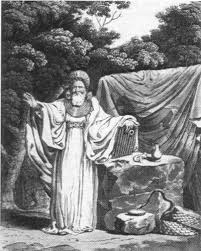
The figure at the heart of the restorative process was the Brehon — the jurist and arbitrator whose role was simultaneously legal, social, and sacred.
Brehons were judges, close in importance to the chiefs. They were similar to judges, though their role was closer to that of arbitrators. Their task was to preserve and interpret the law. During the eighth century, dispute resolution under the Brehon legal framework was administered by Brehons who acted more as arbitrators or mediators than as judges in the modern adversarial sense.
Trials under the Brehon laws were not adversarial, as in modern courts. Instead, an arbitrator — a Brehon — facilitated a process whereby both parties could come to a resolution. The presence and testimonies of witnesses played a crucial role in these proceedings. Witnesses were expected to provide truthful accounts to aid the Brehon in delivering a fair judgment, with their social standing often reinforcing the credibility of their testimony.
Brehons were independent from kings and chieftains. Their role was sacred and above politics, and they were protected by law from interference. Their rulings were binding largely because people trusted them — a powerful idea that modern legal systems might do well to revisit.
The neutrality and authority of the Brehon derived not from institutional appointment or state backing but from the community’s recognition of their wisdom, their training — which could extend across twenty years of formal study — and their demonstrated impartiality. This made their authority simultaneously more fragile and more genuine than state-backed legal authority: more fragile because it depended continuously on the community’s trust, more genuine because it was earned rather than merely conferred.
The mediation process that the Brehon facilitated was structured around the participation of both parties. Both the person who caused harm and the person who suffered it were given voice. The kin groups of both parties were involved — bearing collective responsibility for the outcome on both sides. The community, through the Brehon’s arbitration, arrived at a resolution that all parties understood as fair and could live with, because all parties had participated in shaping it.
The Brehon legal system emphasised the importance of mediation and reconciliation in resolving disputes, providing a framework for resolving conflicts that is both effective and compassionate.
Flexibility and Local Adaptation
One of the Brehon system’s most practically significant characteristics was its flexibility — its capacity to adapt to local circumstances, regional custom, and the specific details of particular cases rather than applying a uniform rule regardless of context.
The Brehon tradition was not a single codified legal system applied identically across all of Ireland. It was a family of related legal traditions, sharing common principles and drawing on a common corpus of legal texts — the Senchas Már, the Críth Gablach, the Bretha Nemed and others — but administered locally by jurists who were expected to understand both the general principles and the specific customs of their own region and community.
The Brehon Laws were sophisticated and addressed various aspects of life, from property and land laws to social transactions and family matters, reflecting the communal values, structures, and approach to maintaining order and resolving disputes of Gaelic society. Within this broad framework, local custom had genuine legal standing: the specific practices of a tuath regarding land use, inheritance, the management of shared resources, or the conduct of seasonal gatherings could supplement and sometimes override the general rules of the legal texts, provided those customs were recognised, consistent, and of sufficient antiquity to carry the community’s endorsement.
This flexibility was not a weakness of the system but a structural feature: the recognition that justice is always contextual, that the specific circumstances of particular people in particular places require particular responses, and that a legal system which ignores those particularities in favour of uniform application is not more just but less. The Brehon who brought the full weight of the tradition’s accumulated wisdom to bear on the specific facts of a specific dispute — navigating between general principle and local circumstance, between the rights of the individual and the welfare of the community — was exercising precisely the kind of practical wisdom that the tradition’s twenty years of formation was designed to develop.
The éigse — the legal assembly, the gathering of knowledgeable persons to deliberate on matters of law — provided the institutional mechanism for the tradition’s ongoing development: new cases, new circumstances, and new social conditions could be incorporated into the tradition’s understanding through the deliberative process of the assembly, ensuring that the law remained responsive to the world it governed.
Social Class, Mobility, and the Obligations of Status
The Brehon system was not egalitarian in the modern sense. Unlike Roman law, people were not equal before the law in Ireland. It was class based in that a person’s legal entitlements depended on social position, birth, and wealth. The lóg n-enech of the king was vastly higher than that of the free commoner, and the commoner’s was higher than that of the unfree fuidir who had lost their standing through poverty or misfortune.
But the system’s relationship to social class was more complex and more humane than simple hierarchy suggests. Social mobility was genuine and legally structured: social mobility was possible within the system. A free commoner who accumulated sufficient cattle to enter into lord-client relationships could rise through the grades of the nobility. A skilled craftsman or poet whose reputation grew could see their lóg n-enech rise with it. A man who failed in his obligations could see his standing fall. The system was hierarchical but not fixed — status was a living condition, continuously responsive to the person’s actual conduct and contribution.
More significantly, the obligations that accompanied high status were genuine and legally enforceable. The noble who failed to protect their clients had violated the terms of the lord-client relationship and was liable for restitution. The king whose governance failed the people forfeited the sacred legitimacy of the kingship. Collective accountability within kinship groups ensured that families raised their members to adhere to societal norms, thus maintaining order and stability within the community.
The Brehon tradition understood that a system in which high status confers rights without obligations is not a legal system but a system of organised extraction — the accumulation of privilege without the corresponding burden of service. The lóg n-enech was always contingent on the actual fulfilment of what that standing required. Nobility was not a possession but a practice.
Property, Commonage, and Sacred Stewardship
The Brehon law of property was rooted in a theological understanding of land as sacred — as the body of the goddess Anu, the sovereign earth to whom the king was married at inauguration and whose welfare he was personally responsible for maintaining.
This understanding produced a law of property in which individual ownership was always conditioned by communal obligation. The principle of tóchar — land stewardship — embedded in the tradition’s approach to property rights reflects the understanding that no one owns the land in the absolute sense; they hold it in trust, responsible for its maintenance and its transmission to future generations in at least as good condition as they received it.
The law of commonage — shared land managed collectively by those who depended on it — required that all users manage their portion responsibly and prevent its degradation. The person who overgrazes the common, who exhausts the shared resource for individual gain at communal expense, is not exercising a property right but violating a sacred obligation. The Brehon tradition provided legal mechanisms for addressing such violations: distraint, compensation, and ultimately the forfeiture of the right to use the common land.
This approach to property has obvious resonances with contemporary discussions of environmental stewardship and the management of shared resources — not because the Brehon tradition anticipated modern ecological thinking, but because both are responses to the same underlying reality: that the land is finite, that its health is the precondition of human welfare, and that legal systems which treat property as an absolute right without corresponding obligation are systems that will eventually destroy the resource base on which all life depends.
The tradition of ArdNemeton understands the Brehon property law as an expression of its broader theological commitment: the earth is sacred, held in trust from the divine, and managed in accordance with the obligations of that sacred trust on behalf of all those — living, dead, and yet to come — who depend upon it.
The Living Relevance
Brehon Law offers a unique and valuable perspective on how to address the complex legal and social issues of the modern world. Its focus on restorative justice, community involvement, and balance and harmony provides a framework for resolving conflicts in a way that promotes healing, reconciliation, and mutual respect.
The tradition did not survive the colonial period intact. The suppression of the Brehon system by English common law — completed after the Flight of the Earls in 1607 — was not merely a legal change but a cultural catastrophe: the destruction of a complete social world in which law, theology, kinship, and land were held together in a single living framework. What was lost was not a primitive legal system replaced by a more sophisticated one, but a sophisticated legal system replaced by a foreign one whose values — adversarial, punitive, property-absolutist, and blind to the communal dimensions of justice — were in many respects inferior to what it displaced.
The recovery of the Brehon tradition’s principles within the Céli Dé community of ArdNemeton is therefore not nostalgia but resistance: the refusal to accept that the colonial legal framework represents the final word on what justice means, and the commitment to governing the community’s internal life according to principles that the tradition has always known to be more adequate to the full complexity of human social life than any purely punitive and adversarial alternative.
Restore harmony. Repair the relationship. Return the community to balance. This is what the Brehon knew. This is what the tradition continues to hold.
References
- Kelly, Fergus (1988). A Guide to Early Irish Law. Dublin Institute for Advanced Studies.
- Binchy, D.A., ed. (1978). Corpus Iuris Hibernici. Dublin Institute for Advanced Studies.
- Brehon Academy: ‘Brehon Law: A System of Justice for Modern Times?’
- ConnollyCove: ‘The Brehon Laws’; ‘Brehon Law: How Ancient Irish Justice Really Worked’.
- Encyclopedia.com: ‘Brehon Law’.
- Higgins, Noelle. ‘The Lost Legal System: Pre-Common Law Ireland and the Brehon Law’.

 ArdNemeton na Tuatha
Leave a comment