A.D. Brock Adams
The Sacred Vocation
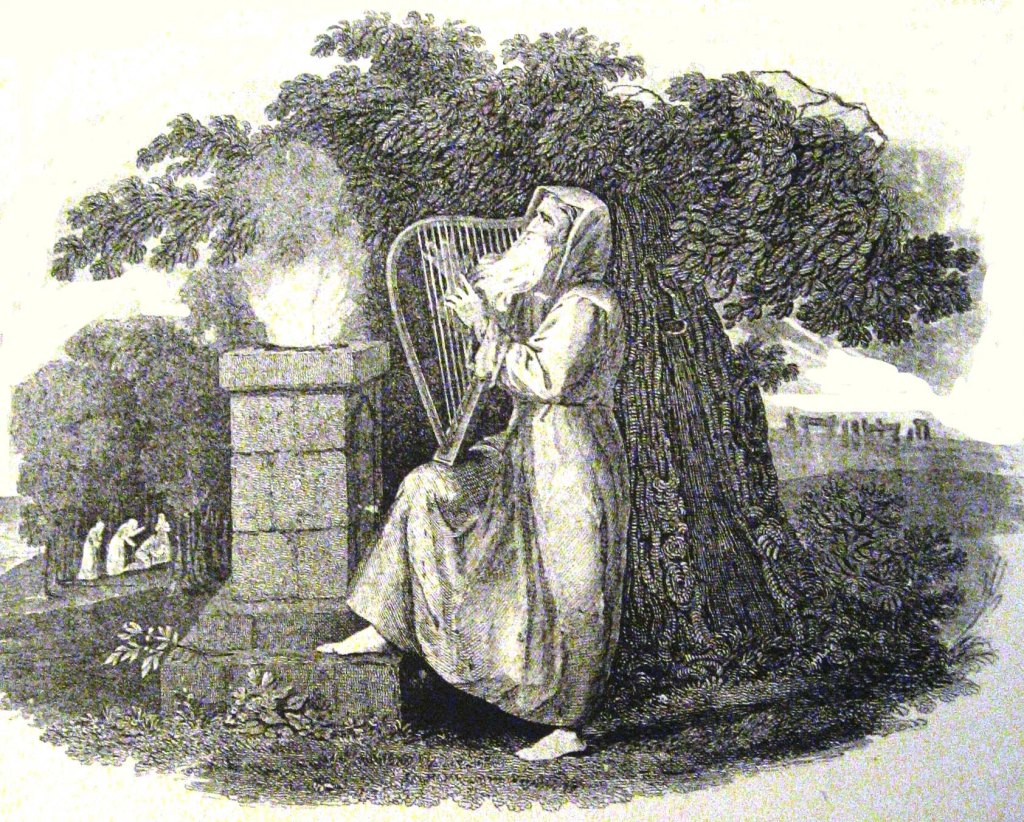
The filidh — the inspired poets of early Ireland — were not entertainers in the modern sense. They were among the most powerful figures in Gaelic society: closer to our modern concept of a CEO than to a musician, the highest-ranking fili — the Ollamh — held exceptional privileges under Brehon Law and carried authority that encompassed poetry, genealogy, prophecy, legal counsel, and the sacred preservation of the community’s entire historical and mythological memory.
When Christianity drove the Druids underground, the filidh took over their roles as teachers, advisors, and witnesses to contracts, and they gradually usurped the important ceremonial roles of the bardic order, becoming the living custodians of everything the tradition needed to survive. They alone — of all social groups except the kings themselves — survived the depredations of the English conquest until the seventeenth century, when the final destruction of the Gaelic aristocratic order at the Battle of Kinsale removed the patronage system on which the bardic schools depended and effectively ended, for a time, the formal institutional transmission of the tradition.
The ArdNemeton tradition recovers and continues that formal transmission through the Bough and Bells system: a graded curriculum of sacred formation rooted in the historical practices of the bardic schools, adapted for the living community of the Céli Dé in the contemporary world.
The Bough and Bells: Symbol and Meaning
As Ollamh — Doctor of Poetry — a practitioner was entitled to receive a gold branch. As Anruth — Noble Stream — they had carried a silver branch, and before that throughout their training they had carried a bronze branch. These branches had bells attached to them, so that as the poet strode into the hall to recite a poem or tell a tale they would be accompanied by the sound of bells — warning the audience to become silent, and summoning the help of the inner realms to ensoul the poem or story.
The bough was not merely decorative. It was a statement of identity, authority, and formation — the visible sign of how many years of rigorous training the bearer had completed, how many tales they carried in their memory, how many metres they had mastered, and what level of sacred authority they were entitled to exercise within the community’s ritual and civic life. The bells were the tradition’s voice announcing itself — the sound that preceded the word, preparing the space for the sacred to enter.
In the ArdNemeton system, the three metals of the bough — Copper, Silver, and Gold — map onto the three great stages of the poet-magician’s formation: the Foundational Years of Copper, the Deepening Years of Silver, and the Mastery Years of Gold. Each metal corresponds not only to a level of knowledge but to a quality of relationship with the tradition: the Copper practitioner is learning to receive it; the Silver practitioner is learning to inhabit it; the Gold practitioner is becoming it.
The Twelve-Year Curriculum
The Ollamh’s colleges were situated at Clogher, Armagh, Lismore, and Tamar, all on notable rivers, later taken over by Christian clergy in the fifth century for seminaries. The process of education appears to have observed seven degrees of wisdom, reflecting key examinations required before progressing to the next stage — resembling the ancient Greek and Latin Trivium and Quadrivium, the lower division consisting of grammar, rhetoric, and logic, the upper concentrating on arithmetic, geometry, astronomy, and harmony.
The formation was uncompromising in its demands. The highest grade, the Ollamh, needed to know 350 tales — primary myths and secondary stories held entirely in memory. As the adage had it: Níba Filí gan Scéla — He is not a poet who does not have stories. The memory was not merely a storage device but a sacred instrument: to hold a tale in the body of the memory was to carry it as a living reality, available for deployment in any context the community required.
A good deal of time was spent in learning by rote, to strengthen the memory and learn the fantastic number of tales and poems required of an accomplished bard. Records from both the Western Highlands and Ireland show that much work was undertaken through the technique we would now term sensory deprivation — the dark chamber of poetic incubation in which Imbas Forosnai was sought, the bodily stillness that prepared the mind for the descent of sacred inspiration.
The Grades in Detail
The Copper Years: Foundation
Cano — Year 1 (Copper Bough, 1 Bell):
The path begins with the Ogham — the sacred alphabetical system of the tradition, each letter named for a tree, each tree carrying its own associations and meanings. The Cano studies fifty Oghams and alphabets, elementary grammar, and twenty tales. The tales are not merely stories — they are the tradition’s foundational mythological and historical memory, the scaffolding upon which all subsequent learning will be built.
Cano — Year 2 (Copper Bough, 2 Bells):
Fifty further Oghams, six elementary lessons in philosophy, specified poems in their formal metres, and thirty tales. The accumulation is deliberate and relentless: each year’s learning builds upon the previous, and nothing learned is permitted to be forgotten.
The Silver Years: Deepening
MacFhuirmid (Apprentice Bard) — Year 3 (Silver Bough, 1 Bell):
The student receives the Silver Bough — a significant threshold, marking the transition from beginner to apprentice. The curriculum expands: fifty Oghams, minor lessons in philosophy, advanced grammar, and forty poems in their formal structures.
MacFhuirmid — Year 4 (Silver Bough, 2 Bells):
The Bretha Nemed — the Law of the Privileged Classes — is introduced. The poet-in-formation must understand the legal framework within which their sacred office exists and which it in turn upholds. Twenty poems of the Eman (births) tradition and fifty tales accompany the legal study.
MacFhuirmid — Year 5 (Silver Bough, 3 Bells):
Advanced grammar and sixty tales. The memory is now carrying a substantial portion of the tradition’s narrative treasury, and the formal structures of the poetic metres are becoming second nature.
Dos (Scholar-Bard) — Year 6 (Silver Bough, 4 Bells):
A second significant threshold — the student is now a Dos, a Scholar-Bard. The secret language of the poets is introduced: the specialised vocabulary and coded speech through which the initiated communicate meanings unavailable to the uninitiated. Forty poems of the Nuath (twins) tradition and seventy to eighty tales accompany this initiation into the tradition’s interior language.
Dos — Year 7 (Silver Bough, 5 Bells):
The Brosnacha — the Miscellanies — and the Laws of Bardism. The Dos now studies the accumulated lore of the tradition’s own self-understanding: what the bardic office is, how it has been practised, what its obligations are, and what its relationship to the broader sacred order of the community entails.
The Golden Years: Mastery
Cano (Druidic Initiate) — Year 8 (Golden Bough, 1 Bell):
The Gold Bough is received — the most significant threshold of the entire formation, marking the transition from the bardic to the druidic register of the tradition. Prosody and glosses — the technical mastery of poetic form at its most refined — are studied alongside the Dinsenchas (Land Lore): the sacred place-name tradition that encodes the mythological history of the landscape into the names of its features.
Most significantly, the three great Druidic visionary practices are introduced: Teinm Laeghda — Illumination of Song — the unlocking of hidden knowledge through sacred chant; Imbas Forosnai — Light of Foresight — the visionary practice of sensory withdrawal and prophetic illumination; and Dichetal do Chennibh — Extempore Incantation — the gift of immediate, spontaneous prophetic utterance, knowledge arising without preparation. These are not techniques to be learned in the modern sense but capacities to be cultivated through the quality of receptivity that eight years of disciplined formation have now made possible.
Cano (Druidic Initiate) — Years 9 and 10 (Golden Bough, 2 and 3 Bells):
Over the following three years, students are termed a Noble Stream — Anruth — because “a stream of pleasing praise issues from him, and a stream of wealth to him.” During this time they learn a further 95 tales, bringing their repertoire up to 175 stories. They study prosody, glosses, prophetic invocation, the styles of poetic composition, specific poetic forms, and the place-name stories of Ireland.
The Sennet, Luasca, Nena, Eochraid (Keys), Sruith (Streams), and Duili Feda (Wisdom Tales) are studied — specialised forms and traditions whose names encode their sacred functions within the broader body of the tradition’s knowledge. The mastery of 175 tales across Years 9–11 is the central project of this stage: these tales are memorised in two separate groups — the primary myths and the secondary stories.
Cli (Master Bard-Druid) — Year 11 (Golden Bough, 4 Bells):
The Cli — the Pillar — stands at the penultimate stage of the formation. One hundred compositions of the Anamuin tradition — the highest form of bardic oration, speech that carries the weight of the tradition’s full sacred authority — are mastered and internalised.
Anruth — Ollamh (Master Poet and Seer) — Year 12 (Golden Bough, 5 Bells):
120 cetals or religious chants and orations, the four arts of poetry, and the completion of the 350 tales — 175 primary myths and 175 secondary stories — held entirely in the living memory of the practitioner. The Ollamh — Doctor of Poetry — was the master whose knowledge encompassed not only poetry and law but the visionary arts and mystical traditions of the order, entitled to a retinue of attendants, to the highest compensatory protections under Brehon Law, and to equal standing with the king and the bishop in the sacred hierarchy of the community.
The Full Curriculum at a Glance
| Rank | Symbol | Year | Training Focus |
|---|---|---|---|
| Cano (Beginner Bard) | Copper Bough, 1 Bell | Year 1 | 50 Oghams, Elementary Grammar, 20 Tales |
| Cano | Copper Bough, 2 Bells | Year 2 | 50 Oghams, Elementary Philosophy, Specified Poems, 30 Tales |
| MacFhuirmid (Apprentice Bard) | Silver Bough, 1 Bell | Year 3 | 50 Oghams, Minor Philosophy, Advanced Grammar, 40 Poems |
| MacFhuirmid | Silver Bough, 2 Bells | Year 4 | Bretha Nemed, 20 Eman Poems, 50 Tales |
| MacFhuirmid | Silver Bough, 3 Bells | Year 5 | Advanced Grammar, 60 Tales |
| Dos (Scholar-Bard) | Silver Bough, 4 Bells | Year 6 | Secret Language of Poets, 40 Nuath Poems, 70–80 Tales |
| Dos | Silver Bough, 5 Bells | Year 7 | Brosnacha, Laws of Bardism |
| Cano (Druidic Initiate) | Golden Bough, 1 Bell | Year 8 | Prosody, Glosses, Three Visionary Arts, Dinsenchas |
| Cano | Golden Bough, 2 Bells | Year 9 | Sennet, Eochraid, Sruith, Duili Feda, 95 Tales (part 1) |
| Cano | Golden Bough, 3 Bells | Year 10 | Continuation of 175-Tale Mastery |
| Cli (Master Bard-Druid) | Golden Bough, 4 Bells | Year 11 | 100 Anamuin Compositions |
| Anruth–Ollamh (Master Poet and Seer) | Golden Bough, 5 Bells | Year 12 | 120 Cetals, Four Arts of Poetry, Completion of 350 Tales |
Rites of Passage
At each significant threshold — MacFhuirmid to Dos, Dos to Cano (Druidic), Cano to Cli, Cli to Anruth–Ollamh — the student undergoes a formal rite of passage before a council of the ordained. The demonstration of mastery is not merely examination in the modern sense but a public enactment: the student performing, reciting, composing, and responding in the presence of those who hold the tradition’s authority, showing not only that they have learned but that they have become what the learning requires.
This is the tradition’s fundamental pedagogical conviction: that formation is not the accumulation of information but the transformation of the person. The Ollamh who emerges from twelve years of this formation is not the same person who entered it at Cano with a Copper Bough and a single bell. They carry 350 tales in their living memory, speak the secret language of the poets, hold the three visionary arts in their practice, understand the law of their office and its sacred obligations, and stand in the community’s sight as a vessel sufficient to receive and transmit what Imbas brings.
As the bough grows heavier with wisdom, so too does the soul of the poet-magician — carrying forward the ancient traditions into the ever-unfolding present, the bells ringing before them as they enter the hall, summoning the silence in which the sacred can be heard.
References
- Kelly, Fergus (1988). A Guide to Early Irish Law. Dublin Institute for Advanced Studies.
- Breathnach, Liam (1983). ‘The Caldron of Poesy’. Ériu 32: 45–93.
- OBOD: ‘What is a Bard?’ (druidry.org).
- Ireland’s Folklore and Traditions: ‘The Filidh: The Senchaidh Sírchuimneach of Medieval Ireland’.
- Breath of Barhrin: ‘Bardic Terms’.

 ArdNemeton na Tuatha
Leave a comment