Why Christ remains in the grove.
One of the questions that arises naturally when people encounter ArdNemeton concerns the place of Christ within our tradition. For some, Druidry and Christianity appear to belong to separate worlds. Others wonder whether the two can meaningfully coexist without one overshadowing the other. These are sincere questions, and they deserve a sincere answer.
The answer begins not with theology, but with the sources.
ArdNemeton was founded upon a simple conviction: before we decide what our traditions ought to be, we should first listen carefully to what our ancestors have left behind. That commitment has led us into the old literature, the poetry, the annals, the folklore, the saints’ lives, the liturgies, the legal traditions, and the devotional practices of the Gaelic world.
As we followed that path, we discovered something that should perhaps have been obvious from the beginning. The overwhelming majority of surviving Gaelic literature, poetry, genealogy, folklore, law, and sacred learning passed through Christian hands. If we wish to understand our ancestors, we must be willing to sit with the sources they preserved and those who preserved them.
This is not merely a matter of historical convenience. It is a matter of listening honestly.
To remove Christianity entirely from the story would be to remove centuries of Gaelic memory along with it.
The scribes who copied the manuscripts, the monks who preserved learning, the poets who composed devotional verse, and the communities who carried prayers and customs from one generation to the next were not standing outside Gaelic culture. They were participants in it. Their voices became part of the great conversation through which the Gaelic peoples understood themselves and their place in the world.
For this reason, ArdNemeton does not approach Christianity as a foreign addition to our studies. Neither do we treat it as the sole lens through which everything must be viewed. Rather, we encounter it as one of the great streams that has flowed through the Gaelic tradition for well over a millennium.
The image of a river may be helpful here. A river is not defined by a single spring. It gathers waters from many sources as it travels. Some streams join it in the mountains. Others emerge from hidden wells. Still others enter far downstream. Over time, these waters become inseparable, contributing to the character of the river as a whole.
So it is with the Gaelic inheritance.
The stories of the Tuatha Dé Danann, the wisdom of the poets, the customs of ordinary households, the prayers of the saints, the devotion of the Céli Dé, the blessings gathered in the Carmina Gadelica, and the learning preserved in monasteries all belong to the landscape through which we travel. They do not erase one another. They stand beside one another, sometimes in tension, often in harmony, always in conversation.
What interests us is not the impossible task of separating every strand from every other strand. Rather, we seek to understand how those strands were woven together in the lives of real people. The woman blessing her hearth in the Hebrides was not conducting an archaeological reconstruction. The monk illuminating a manuscript was not imagining himself the end of history. The farmer marking the turning of the seasons, the pilgrim visiting a holy well, the poet composing praise, and the storyteller preserving ancient tales all inhabited a world where memory accumulated rather than replacing itself.
This is one of the reasons the Céli Dé hold such fascination for us. Whether in history or in legend, they stand at a meeting place of traditions. They remind us that faith and learning, devotion and culture, inheritance and renewal need not be enemies of one another. They invite us to see the spiritual life not as an act of choosing between roots, but as an act of tending them.
For many people, Christianity is encountered primarily as an institution or as a system of doctrines. Those things have their place, but the Christianity that emerges from the Gaelic sources often feels different in character. It is encountered in blessings spoken over the morning fire, in prayers offered before travel, in songs sung while working, in hospitality shown to strangers, and in an awareness that the sacred is woven throughout the ordinary rhythms of life.
Christ appears not only in churches, but in fields, on shorelines, beside hearths, along roads, and upon doorsteps.
He is encountered not as an abstraction, but as a living presence moving through the world that people inhabited, and still inhabit, every day.
It is this Christ who appears so frequently in the surviving Gaelic imagination, and it is this Christ who continues to speak through many of the sources we study.
For ArdNemeton, this encounter leads still further. We perceive in Christ not a departure from the deepest currents of the Gaelic tradition, but their fulfilment. In the old triadic understanding we discern Belinos, source of life and light; Taranis, whose voice was heard in the thunder; and Tuathatis, Lord of the People. When the Gospel reached the Gaelic world proclaiming Iesus, we understand it not as the arrival of an entirely foreign figure, but as the revelation and incarnation of the One whom our ancestors had already sought through the image of the Lord of the People, Esus. In this understanding, the resonance between Esus and Iesus is not merely linguistic and symbolic, but integral, pointing toward a deeper continuity of meaning.
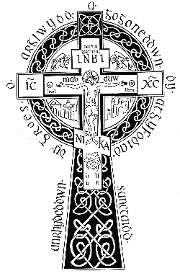
The significance of the Tree is equally profound. In the traditions associated with Tuathatis, justice, sacrifice, and the maintenance of sacred order were bound together. The Lord of the People was guardian of the folk and keeper of right relationship within the tribe. Christ’s crucifixion upon the Tree is therefore understood not as an isolated event, but as part of a pattern already present within the older inheritance. Through the grace of the Theotokos, the Lord of the People entered history in a particular time and place, taking flesh among humanity while remaining Lord of all peoples and all ages. What had once been perceived through symbol, story, and sacred memory became manifest through incarnation. Thus we understand the traditions not as strangers meeting one another across a divide, but as a single inheritance unfolding through time and revealed more fully in Christ.
Whether one ultimately approaches these traditions as a Christian, a Druid, both, or neither is a matter of conscience. ArdNemeton does not demand uniformity of belief. What we ask instead is that the sources be given a fair hearing in Cathaireachd. If we are willing to listen to the voices that have come down to us, we may discover that the old conversation is richer and more nuanced than modern categories often allow.
In the end, Christ remains present in ArdNemeton for the same reason that the old stories remain present, the old prayers remain present, and the old language remains present. They are part of the inheritance we have received. We did not place them there. We found them waiting for us along the deer path, and our task is simply to walk a little farther and listen to what they still have to say.


Leave a Reply