When discussing the foundational texts of the Gaelic spiritual tradition, attention naturally falls upon works such as the Lebor Gabála Érenn, the Saltair na Rann, the Stowe Missal, and the rich devotional heritage preserved in the Carmina Gadelica. These texts provide the mythic history, sacred cosmology, liturgical practice, and folk spirituality that form the heart of the Gaelic worldview.
Yet there exists another work that deserves a place beside them: the Scotichronicon.
Compiled during the fifteenth century by Walter Bower, Abbot of Inchcolm, the Scotichronicon is one of the great chronicles of medieval Scotland. At first glance it appears to be a historical record, but like many medieval chronicles it is far more than a simple account of events. It is an attempt to understand the story of a people through the lens of divine providence. Beginning with Creation itself and continuing through the kings, saints, and struggles of Alba, the chronicle presents history as a sacred unfolding rather than a collection of disconnected facts.
This approach should feel familiar to anyone who has studied the Lebor Gabála Érenn. Both works seek to answer the same fundamental question: Who are we, and how did we come to be here?
The Lebor Gabála answers by tracing the migrations of the peoples who settled Ireland, connecting Gaelic ancestry to the wider story of the world through Biblical genealogy and sacred tradition. The Saltair na Rann places those same traditions within a sweeping vision of sacred history stretching from Creation to the Last Judgment. The Scotichronicon continues that work from the perspective of Alba, preserving the memory of how medieval Scots understood their origins, their kings, their saints, and their place within God’s design.
For ArdNemeton, the significance of the Scotichronicon lies in its preservation of the Gaelic vision of the world. It belongs to an age in which history, theology, ancestry, poetry, and sacred tradition were understood as parts of a single reality rather than separate disciplines. The chronicle does not merely recount events; it reveals how a people understood themselves, their origins, their duties, and their relationship to God. In its pages, memory becomes history, history becomes meaning, and meaning becomes a path toward wisdom. Its value lies in what it reveals about the spiritual imagination of the medieval Gaels. It belongs to a time when history, mythology, theology, and collective memory were not separated into competing categories. They were understood as different facets of a single truth.
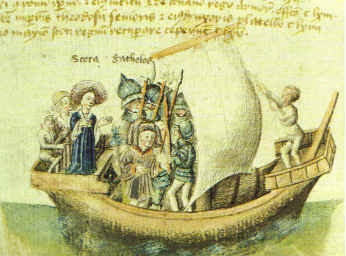
The chronicle preserves traditions linking the Scots of Alba to the Gaels of Ireland through the ancestral figures of Goídel Glas and Scota. It records the deeds of kings and saints, the founding of monasteries, the struggles of nations, and the preservation of faith. In doing so, it becomes a witness to a distinctly Gaelic Christian vision of the world—a vision in which the sacred is woven into the fabric of everyday history.
This makes the Scotichronicon a natural companion to the other texts held in esteem within ArdNemeton.
The Lebor Gabála Érenn provides the mythic origins of the Gaels.
The Saltair na Rann places those origins within the grand drama of sacred history.
The Stowe Missal preserves the liturgical life of the Gaelic Church.
The Carmina Gadelica records the prayers and devotions of the people.
The Scotichronicon supplies the historical memory of Alba, preserving how the northern branch of the Gaelic world understood its place within that same sacred story.
Taken together, these works form the tapestry of a canon in the broad sense. They are witnesses—voices from different centuries preserving fragments of a shared inheritance. Through them we encounter the cosmology, history, devotion, liturgy, folklore, and spiritual imagination of the Gaelic peoples.
Within the ArdNemeton tradition, the Scotichronicon may therefore be regarded as The Chronicle of Alba: the Scottish witness to the sacred history of the Gaels. Read alongside the Irish chronicles and liturgical texts, it reminds us that the story of the Gaelic peoples was never confined to a single shore. It belongs equally to Éire and Alba, to the saints and the poets, to the kings and the common folk, and ultimately to all who seek wisdom within the living tradition of the Gaels.
For those exploring the spiritual heritage of ArdNemeton, the Scotichronicon offers something invaluable: not merely a record of what happened, but a vision of how our ancestors understood the relationship between history, memory, and the Divine.


Leave a Reply