One of the recurring themes of ArdNemeton is that truth is rarely confined to a single tradition. The wisdom of the Druids, the philosophers of Greece, the mystics of Christianity, the sages of India, and even the discoveries of modern science often appear to describe the same reality through different languages. The Omnist seeks neither to erase these differences nor to reduce them to a single dogma, but to recognize the underlying pattern that unites them.
Among the most universal of these patterns is the Trinity.
In Christianity we find Father, Son, and Holy Spirit. In Hinduism we find Brahma, Vishnu, and Shiva. Among the Celtic peoples we encounter Belinos, Taranis, and Teutatis. Similar triads appear throughout the ancient world. Rather than viewing these as separate gods competing with one another, Omnist Druid theology may understand them as manifestations of a single universal Trinity expressed through different cultures.
At the cosmological level, these three principles correspond to the fundamental powers through which creation is sustained.
The first is the principle of Attraction, reflected physically through gravity. It gathers matter together, forms stars and galaxies, and draws all things toward unity.
The second is the principle of Manifestation, reflected through electromagnetism. It is the force of light, fire, energy, communication, and revelation. Through it the universe becomes visible and knowable.
The third is the principle of Transformation, reflected through the strong and weak nuclear forces. It governs the hidden changes within matter itself, the birth and death of stars, and the continual cycle of becoming.
Thus the ancient Trinity may be understood not merely as a theological symbol but as a reflection of the fundamental architecture of existence.
The Galactic Trinity
If the microcosm reflects the macrocosm, then these principles may be observed at every scale.
Consider our galaxy.
The visible galactic body, containing countless stars, worlds, and streams of life, may be likened to Brahma, the creative expression of cosmic order.
At its center lies the supermassive black hole, an invisible power around which the entire structure revolves. This may be likened to Shiva, the transformer and dissolver, the mystery that both consumes and renews.
The dynamic relationship between these poles—the galaxy and its hidden center—creates the living system itself. This totality corresponds to what many Gnostic traditions called Yaldabaoth.
In this understanding, however, Yaldabaoth is not an evil being. Rather, it is the cosmic organism of our universe: the great architect of manifested existence, the living structure within which worlds, stars, and souls arise.
Yet even this vast cosmic being is not God.
A galaxy is finite.
A universe is finite.
Even the totality of all manifested existence remains limited.
God transcends every manifestation.
Just as a cell cannot fully comprehend the body in which it lives, Yaldabaoth itself exists within a greater reality. God is not merely the creator of a universe but the infinite source from which all universes emerge. Every galaxy, every cosmos, every realm of being exists within the boundless life of the Divine.
Iolo’s Three Worlds
This perspective provides an intriguing way to revisit the Three Worlds described by Iolo Morgannwg.
Whether one accepts Iolo’s work as ancient tradition, inspired reconstruction, or mystical philosophy, the model remains profoundly useful.
The first world is Abred (Adharta), the realm of necessity, struggle, limitation, and incarnation.
The second world is Gwynfyd (Saoirse), the realm of liberty, wisdom, and spiritual awakening.
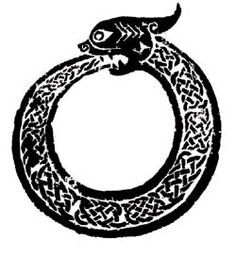
The third world is Ceugant (Sioruidheachd), the infinite circle that surrounds all things and can be inhabited only by God.
Within Omnist Druid theology these worlds may be viewed cosmologically.
Abred corresponds to the manifested cosmos itself. It is the realm governed by the Trinity of forces. Here souls experience separation, growth, suffering, learning, and transformation. It is the domain of galaxies, stars, planets, and all embodied existence. In symbolic terms, it is the realm of Yaldabaoth.
Gwynfyd represents awakening to the deeper unity hidden beneath apparent division. Here the soul begins to perceive the universal Trinity operating through all traditions and all forms. The distinctions between religions, cultures, and symbols gradually dissolve as the underlying pattern becomes visible.
Ceugant remains forever beyond manifestation. It is the Holy place within creation where in the infinite mystery from which creation itself emerges comes to recognise itself. It is the source beyond all universes, beyond all gods, beyond all names, beyond even Yaldabaoth. It is God in the fullest sense. As each drop reflects the ocean, so too do we reflect that glory.
The Journey of the Soul
The spiritual journey may therefore be understood as movement through increasing levels of perception.
At first, one perceives only the material world.
Later, one begins to perceive the living patterns that shape it.
Then one recognizes that every tradition points toward the same fundamental realities through different symbols.
Finally, one realizes that even the greatest cosmic powers are themselves manifestations of a reality beyond and within all manifestation.
The Trinity is not merely a doctrine.
The galaxy is not merely a collection of stars.
The Three Worlds are not merely stages of existence.
Each is a reflection of a deeper truth: that the structure of reality repeats itself across every scale of being. The atom reflects the star. The soul reflects the cosmos. The cosmos reflects the Divine.
As above, so below.
As within, so without.
And beyond all circles, beyond every world and every universe, lies Ceugant—the Infinite Mystery from which all things arise and to which all things ultimately return.


Leave a Reply