If you have arrived here for the first time, you may be wondering what, exactly, ArdNemeton is. That is a reasonable question. There is a great deal here: discussions of Druidry and Christianity, Gaelic language and literature, mythology and poetry, Brehon law and Ogham, ritual and cosmology, history and ethics, hospitality and community, sacred speech and comparative religion. There are lessons, prayers, ceremonies, legal studies, wisdom texts, declarations, essays, and explorations of subjects that can initially seem to have little connection with one another.
It can be difficult to see the forest when you are standing among the trees. This essay is an attempt to step back and show you the forest.
ArdNemeton is a living tradition
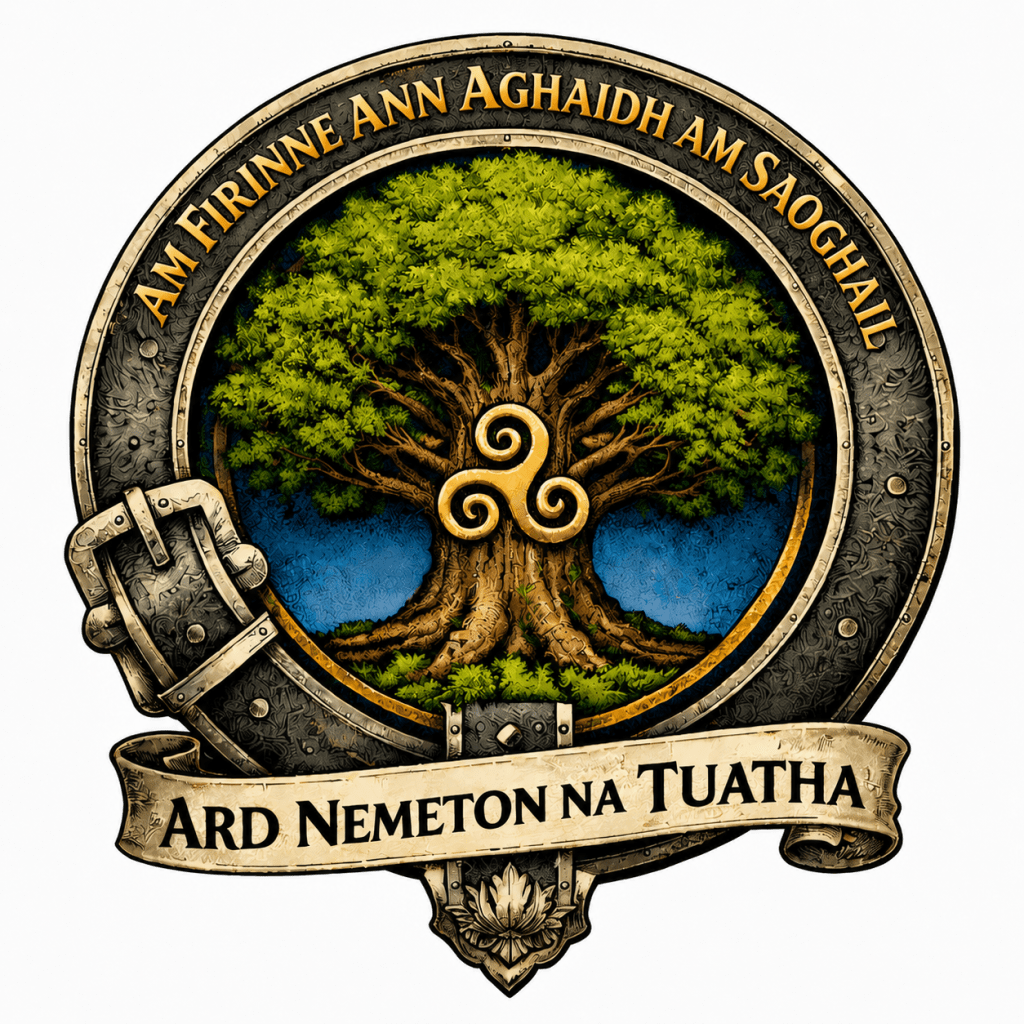
ArdNemeton na Tuatha—the High Grove of the Peoples—is a contemporary Gaelic spiritual and Bardic tradition rooted in the intellectual, literary, spiritual, and cultural inheritance of Ireland and Scotland, and growing here on Turtle Island.
It is not simply a reconstruction of ancient Druidry. Nor is it Christianity dressed in Celtic imagery. It is not merely a cultural society, a historical study group, a church, or a collection of modern spiritual practices. There are elements of all of these things here, but none of them describes the whole.
ArdNemeton is an attempt to cultivate a living tradition: one grounded in the sources of the Gaelic world, informed by historical study, shaped by spiritual practice, and capable of speaking to the circumstances of people living in the modern world. The purpose is not to pretend that we can step backwards into an imagined ancient past. The purpose is to take seriously what our ancestors left us and ask what can still grow from those roots.
This is why study matters so much here. The old Gaelic learned traditions placed extraordinary value upon learning. Poetry, genealogy, law, history, language, mythology, theology, rhetoric, and memory were not isolated academic subjects. Together they formed a way of understanding the world and one’s place within it. Knowledge was supposed to change the person who possessed it.
That principle remains central to ArdNemeton. The lessons, Triads, Ogham studies, wisdom literature, legal texts, poetry, and spiritual practices are not independent collections of material. They are different instruments of formation. The purpose of learning is not simply to know more, but to become more capable of seeing, judging, remembering, creating, serving, and living rightly.
For this reason, ArdNemeton is perhaps best understood as a wisdom school.
You are not expected to believe everything simply because it appears on this website. You are expected to read, question, compare, think, practice, return to the sources, and, when necessary, change your mind. The pursuit of understanding is itself regarded as a spiritual discipline.
Why the reading list matters
One of the best ways to understand ArdNemeton is to look beneath its teachings and ask where they came from. That is the purpose of the Suggested Reading List.
The reading list is not simply a bibliography attached to the bottom of a website. It is a map of the intellectual landscape from which ArdNemeton has grown. It points toward primary texts, scholarship, historical sources, literary traditions, and comparative materials that have informed the work here.
Among those sources are the great bodies of Gaelic myth, poetry, religious literature, law, history, and devotional tradition. The Lebor Gabála Érenn preserves a mythological history of Ireland and its successive peoples. The Saltair na Rann carries sacred history from Creation toward the Last Judgment through the extraordinary poetic tradition of medieval Ireland. The Stowe Missal and other liturgical sources reveal the Christian religious world of early medieval Ireland, while the Carmina Gadelica preserves a much later body of Gaelic prayers, blessings, charms, songs, and devotional material.
The legal texts, including works such as the Uraicecht Becc, Dín Techtugad, and Senchas Már, reveal something equally important: a society in which questions of justice, status, obligation, property, professional responsibility, hospitality, and right conduct were matters of serious intellectual and moral concern.
The Scotichronicon reminds us that the Scottish Gaelic inheritance cannot be reduced to folklore and mythology. Medieval Scottish writers also understood history itself as a sacred story: a story of peoples, kings, saints, providence, memory, and place.
The reading list therefore tells us something fundamental about ArdNemeton. Its foundation is not the revelation of one modern individual. It is a conversation with a very large body of inherited material. We are listening to many voices.
The Gaelic tradition is larger than modern categories
One of the problems with approaching the Gaelic world from the modern perspective is that we tend to divide things into categories that our ancestors did not necessarily keep separate. Religion goes into one box, law into another, literature into another, history into another, folklore into another, and science and philosophy somewhere else.
The surviving Gaelic tradition repeatedly crosses these boundaries.
A legal text can contain theological assumptions. A poem can preserve cosmology. A saint’s life can preserve older cultural memories. A prayer can encode an understanding of the natural world. A myth can become part of a Christian literary tradition. A chronicle can become an account of sacred history.
This interconnectedness is one of the reasons ArdNemeton studies such a broad range of material. The pieces belong together.
Why Christianity is here
Perhaps nothing illustrates this better than the place of Christianity within ArdNemeton.
For some modern Druids, Christianity represents an intrusion that must be removed before an authentic pre-Christian tradition can be recovered. For some Christians, Druidry represents something that Christianity must displace. ArdNemeton does not begin from either assumption. It begins with the historical record.
The overwhelming majority of surviving Gaelic literature, poetry, law, genealogy, folklore, liturgy, and learned writing passed through Christian hands. The monks and scribes who preserved these materials were not outsiders observing Gaelic culture from somewhere beyond it. They were participants in the Gaelic world.
If we remove Christianity from that inheritance, we do not recover an untouched ancient tradition. We simply remove a millennium or more of Gaelic memory.
But there is another danger. If we remove the Druidic wisdom, then the authoritarian tendencies of Christianity run wild and free.
This is one of the reasons ArdNemeton refuses the false choice between an imagined, pristine pre-Christian past and an unchallenged Christian orthodoxy. The Gaelic inheritance contains both the Christian tradition and the older intellectual and spiritual traditions with which Christianity encountered, argued, adapted, and lived alongside. To discard either side is to impoverish the inheritance we have actually received.
That does not mean that every Christian interpretation of Gaelic tradition must be accepted. It means that Christianity must be listened to alongside the other voices preserved within the tradition—and that it must itself be subject to the same critical examination as everything else.
This is why Christ remains in the grove.
ArdNemeton understands the Christian inheritance as one of the great streams running through Gaelic history, and seeks to understand how Christian devotion, older traditions, poetry, folklore, law, learning, and popular practice interacted across the centuries. The result is not an attempt to choose between “Druidry” and “Christianity,” but to explore the complicated tradition that actually existed.
The Céli Dé are especially important here. They were learned and devotional figures who occupied a fascinating place at the meeting of scholarship, asceticism, poetry, Christianity, and Gaelic culture. The question is not simply whether they were “Christian” or “Druid.” The more interesting question is what their existence tells us about how Gaelic people actually understood the relationship between learning, devotion, culture, and sacred tradition.
One Divine Reality, many names
ArdNemeton’s theology is likewise deliberately broad.
The Nine Affirmations begin with the One Mystery: an infinite and ultimately unknowable Divine Source from which all things proceed and in which all things abide. From there follows the recognition that humanity has encountered that Divine Reality through many names, traditions, symbols, gods, goddesses, angels, saints, spirits, and sacred figures.
This is not a claim that all religions are identical.
It is instead an affirmation that no human tradition possesses the whole of the Divine Reality. The work of the seeker is therefore not to build a wall around truth, but to pursue wisdom wherever genuine wisdom may be found.
This is the principle behind the Omnist dimension of ArdNemeton and behind its willingness to place Gaelic material into conversation with Christianity, classical philosophy, other religious traditions, comparative mythology, and modern scientific thought. The point of comparison is not to flatten everything into sameness. It is to listen for resonance without losing difference.
The Earth is sacred
The spiritual life of ArdNemeton is also profoundly concerned with place.
The Earth is not merely scenery surrounding religious activity. Creation is itself sacred. The forest, river, mountain, sea, sky, sun, moon, and living creatures belong to the sacred order.
The old image of the nemeton—the sacred grove—is therefore more than a picturesque name. It expresses something fundamental. A grove is a place where human beings enter into a relationship with the larger world. It is a place of meeting, memory, and learning; a place where the boundaries between human community and the wider creation become less rigid.
This is why ArdNemeton speaks so often of roots, trees, rivers, paths, fires, seasons, and the land. These are not merely decorative metaphors. They are ways of remembering where we stand.
We have not been abandoned by the Divine
The Nine Affirmations also reject the idea that humanity is fundamentally worthless, corrupt, or born separated from God.
ArdNemeton instead understands the human problem in terms of forgetting. We have forgotten where we are. We have forgotten what we are. We have forgotten our obligations to one another and to the world around us.
The spiritual task is therefore one of remembrance.
The Earth is not a prison from which we must escape. It is the garden in which we have been placed. The work is to remember that garden and make our lives worthy of it.
That has ethical consequences. If wrongdoing causes harm, then the appropriate response is not simply to declare ourselves forgiven and move on. There must be repair. There must be restoration. There must be responsibility.
Wisdom must become action.
Law belongs in the grove
This is one reason Brehon law occupies such an unusual place on the site.
Modern spiritual movements sometimes treat ethics as a matter of personal preference. The Gaelic legal tradition offers a very different perspective. It asks what we owe one another. What constitutes justice? What does hospitality require? What obligations accompany status? What happens when someone causes harm? What responsibilities belong to a teacher, poet, judge, ruler, cleric, or member of a community?
These are spiritual questions because they concern the quality of our relationships.
The Senchas Már is particularly important because it demonstrates the complexity of the Gaelic legal inheritance and the interaction between native Irish jurisprudence and ecclesiastical law. Rather than imagining that Christianity simply erased an earlier legal system, the surviving material shows a process of adaptation, negotiation, and synthesis.
This is characteristic of the tradition ArdNemeton seeks to understand. It does not grow by replacing everything that came before. It grows by remembering, adapting, and incorporating.
Hospitality is sacred
If there is one principle that appears again and again throughout the work of ArdNemeton, it is hospitality.
The stranger is not merely someone standing outside the community. The stranger is someone who may need a place at the fire.
The old Gaelic world placed extraordinary importance upon hospitality, obligation, reputation, generosity, and the duties of host and guest. ArdNemeton treats that inheritance as more than historical curiosity.
A spiritual community should be a place where people can arrive without already knowing all the answers. A person should be allowed to ask difficult questions. Doubt should not automatically be treated as betrayal. Learning should not require submission.
The fire should remain lit.
This is the meaning behind the image of ArdNemeton as a grove, an inn, and a place at the crossroads. There are many paths through the forest. People arrive from different directions. Some are carrying faith. Some are carrying doubt. Some are carrying scholarship. Some are carrying grief. Some are simply curious.
The first responsibility is not to interrogate them. It is to offer them a seat.
The Bardic path
The word “Bardic” is important here.
The ancient poet was not simply an entertainer. The learned orders preserved language, genealogy, history, law, praise, satire, memory, and sacred knowledge. The poet was therefore a custodian of cultural memory.
That vocation lies behind ArdNemeton’s emphasis upon language, poetry, Ogham, rhetoric, mythology, and disciplined study.
The twelve-year curriculum associated with the traditional Irish learned schools, preserved in the educational descriptions collected by Eugene O’Curry, provides an important model for understanding this approach. The point is not to recreate medieval examinations in a modern living room. It is to recover the idea that becoming learned takes time.
A person does not become a poet, teacher, priest, judge, or spiritual guide merely by declaring themselves one. Authority must be cultivated. Knowledge must be tested. Character must be formed. Service must accompany learning.
This is why the Bough and Bells, the studies of Ogham and poetry, and the broader curriculum exist. They belong to the same project.
The Cathaireachd
ArdNemeton is not intended to be a spiritual path in which one individual stands at the centre and everyone else simply receives instruction.
The Cathaireachd exists because wisdom belongs to the community as well as the individual. A Cathaireachd is an assembly: a place for conversation, learning, deliberation, judgment, and communal decision-making.
It provides a structure within which people can disagree without becoming enemies and within which authority can be questioned rather than treated as unquestionable.
That matters because ArdNemeton is not intended to be a finished system. It is a living tradition.
A living tradition must be capable of conversation. It must be capable of correction. It must be capable of growth.
The Golden Path
This is perhaps the central image of the entire project.
We inherit fragments. Some come from ancient Ireland, some from medieval Scotland, some from Christian monasticism, some from the poets, some from the law, some from folklore, some from the modern revival of Druidry, some from contemporary scholarship, and some from our own lived experience.
The task is neither to worship the past nor to discard it. It is to walk between memory and renewal: to preserve what deserves preservation, question what deserves questioning, repair what has been damaged, let dead things remain dead, and allow living things to grow.
That is the Golden Path.
What ArdNemeton asks of you
You do not have to know Gaelic before entering the grove. You do not have to be an expert in Celtic history. You do not have to accept every proposition you encounter here. You do not even have to know what you are looking for.
Curiosity is sufficient to begin.
What ArdNemeton asks is simpler and more demanding: read carefully, think seriously, practice what you learn, question what you do not understand, listen to the sources before deciding what they ought to say, treat other people with hospitality, and leave the world better than you found it.
And above all, seek wisdom wherever it may be found.
Where should I begin?
If you are new to ArdNemeton, do not attempt to read everything. You will drown.
Instead, begin with the foundational material. Read Why ArdNemeton Exists to understand the question from which the project grew. Read The Nine Affirmations to understand its theological and ethical foundations. Read The Deer Path Between Oak and Cross to understand why Christ remains central to a tradition drawing upon Druidic and Gaelic sources. Read The Gaelic Bardic Path to understand the educational vision. Read The Golden Path to understand the relationship between inheritance and renewal. Read about the Cathaireachd to understand how community and authority are conceived.
Then begin exploring the actual sources.
Read the Saltair na Rann. Explore the Senchas Már and the other legal texts. Read the poetry and the mythology. Read the Scottish chronicles. Explore the Carmina Gadelica. Study Ogham. Listen to the language. Read the prayers.
And when something here makes you uncomfortable, do not immediately close the book.
Ask why.
The old traditions deserve enough respect to be taken seriously, including when they challenge us.
The reading list is the map
The Suggested Reading List exists because ArdNemeton is not meant to be a closed world. It points outward: toward books, manuscripts, scholarship, other communities and institutions, and sources that may confirm what we believe as well as sources that may challenge it.
That is intentional.
ArdNemeton does not ask you to trust us instead of reading the sources. We want you to read the sources.
The more deeply you explore them, the more clearly you will understand what this project is attempting to do.
Welcome to the grove
So, what is ArdNemeton?
It is a grove, a school, a community, a spiritual path, a place of study, and a place of practice. It is a place where old books are opened and old questions are asked again, and again, and again.
It is an attempt to bring the Gaelic intellectual and spiritual inheritance into conversation with the world in which we actually live. It is rooted in Ireland and Scotland, but it has grown in Canada. It remembers the old roads without pretending that we still live in the world through which those roads originally passed.
It takes Christianity seriously without allowing Christianity to erase the rest of the Gaelic inheritance. It takes Druidry seriously without pretending that modern Druidism can simply reproduce antiquity. It takes scholarship seriously without believing that scholarship is the only form of knowing. It takes spirituality seriously without demanding unquestioning belief. And it takes community seriously enough to believe that wisdom should eventually become service.
The image that best describes the whole project remains the simplest one: a tree.
Its roots reach backward into memory. Its trunk stands in the present. Its branches reach toward a future that does not yet exist. Its seeds are carried outward into places we cannot yet see.
That is ArdNemeton.
A new tree grounded in ancient roots, growing in the soil of Turtle Island, with its branches reaching toward whatever the future may bring, dancing in the winds of fate.
Fàilte gu ArdNemeton na Tuatha.
Welcome to the grove.


Leave a Reply