Inevitably, the question arises: how can Christianity and Druidism be reconciled?
In truth, the conflict is often greater in modern imagination than it was in historical reality. Church historians frequently present the coming of Christianity as a triumph over the Druids, yet Ireland itself is famous for having no tradition of blood martyrs. The conversion of Ireland appears to have been more a transformation than a conquest.
The story of Saint Padraig driving the snakes from Ireland is a good example. Ireland never had native snakes; the climate and geography made that impossible. More interesting is an old Druidic prophecy said to describe his coming, referring to him as “adze-headed.” Whether this originally referred to a tool, a monastic cowl, or was later reinterpreted by Christian scribes is difficult to know. What is clear is that the description was considered unusual enough to be remarked upon. If the story preserves any genuine memory, it may tell us more about the appearance of early monks than it does about serpents.
What is often overlooked is how quickly many Druids and Ollamhs entered the new order. The very people who had once preserved sacred knowledge through memory became the scribes of the great Irish scriptoria. There, they began writing down traditions their predecessors had forbidden to be written. Was this rebellion against the old ways, or their preservation? History leaves the question unanswered.
The transition itself was remarkable. In a surprisingly short time, the intellectual class of Ireland shifted from the Druid colleges to the monasteries. Yet the people, the language, the customs, and much of the worldview remained. The old roots were not torn out. They were grafted onto a new trunk.
One of my favourite examples comes from Brehon Law. Under the older customs, abandoning a legal complaint through sudden forgiveness could itself be considered an offence. A person who forgave his opponent in the middle of proceedings might be required to compensate the court for wasting its time. Christianity introduced a different emphasis. Mercy, reconciliation, and forgiveness became virtues that could stand alongside justice. The law was not replaced overnight; rather, its sharper edges were softened.
The same pattern appears in religion. Christianity arrived in Ireland with comparatively few established customs of its own. Rather than destroying everything that came before, it often absorbed and transformed what it encountered. The old framework remained, but its meaning evolved. Druids and Filidh became Céli Dé. Sacred wells remained sacred. Holy days remained holy. Prayers replaced invocations, yet many of the rhythms of life continued unchanged.
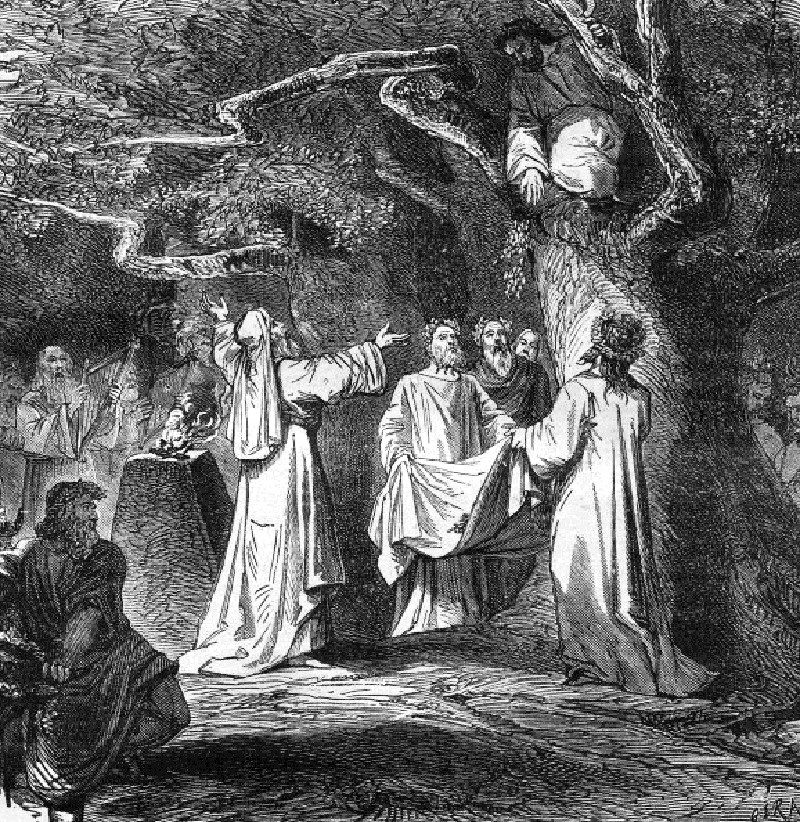
This is why I do not see Christianity and Druidism as antagonists. Nor do I see them as identical. Rather, I see them as traditions that, in Ireland, grew together so closely that separating them completely becomes almost impossible. Like the mistletoe growing upon the oak.
ArdNemeton is, first and foremost, a Druidic tradition. We approach the world through the wisdom of the Druids, the teachings of the Filidh, and the customs of our ancestors. Yet we also recognize the insights brought by Christianity, which became so deeply woven into the fabric of Ireland that it cannot be entirely separated from our inheritance.
So when people ask whether ArdNemeton is Christian, Druidic, or Pagan, my answer is simple:
Yes.
It is Druidic in its love of nature, wisdom, poetry, and the sacredness of the world; in the ancient laws and teachings of our people; in our understanding of the Otherworlds and the Great Hereafter; and in the belief that the Divine is present throughout creation.
It is Christian in its reverence for the teachings of Christ, the saints, mercy, forgiveness, and prayer.
It is Pagan in remembering the old gods, the old stories, and the ancestral traditions that shaped our peoples; and in the understanding that Christ is an incarnation of one of our gods.
ArdNemeton is not interested in choosing one inheritance and discarding the others. It seeks instead to tend the flame of truth that survived them all.
 ArdNemeton na Tuatha
Leave a comment