A.D. Brock Adams
What Is a Nemeton?
The word nemeton derives from the Proto-Celtic nemeto — a sacred or holy place, set apart from the ordinary world. Nemeta were primarily situated in natural areas, most often interpreted as sacred groves, though the evidence suggests the word encompassed a wider range of ritual spaces, including shrines and open-air sanctuaries. What distinguished them from the enclosed temples of the Mediterranean world was precisely their openness: the sky above, the soil below, and the living canopy of trees as their only roof.
Toponyms related to the word nemeton occur across the entire Celtic world — as far west as Galicia in the Iberian peninsula, as far north as Scotland, and as far east as central Turkey — testament to a sacred concept that travelled wherever the Celts went and put down roots as surely as the oaks they venerated. The goddess Nemetona — she of the sacred grove — was the presiding deity of these spaces, and Druids oversaw all ceremonies conducted within them.
This mode of worship stood in deliberate contrast to the enclosed sacred buildings that developed within later Christian and Roman religious practice — structures shaped in part by historical pressures, periods of persecution, and the institutional needs of an expanding church. The Druid understood divinity as most fully present in the living world: to build a roof over the sacred was not to honour it, but to diminish it.
Form and Function
The nemeton was not standardised in its physical form, but common elements recur across the archaeological and literary record. Typically it centred on a great tree or cluster of trees — most often oak or yew — under whose canopy initiations were conducted, judgements rendered, and the dead laid to rest. Surrounding rings of stones, earthworks, and ditched embankments demarcated the sacred boundary, serving as clear physical and spiritual separation between the mundane world and the sacred space. These embankments were sometimes terraced or stepped, allowing the wider community to observe the rituals from a respectful distance while maintaining the integrity of the inner rite.
Archaeological evidence confirms what the textual sources describe. At what must have once been sacred areas, votive plaques have been found from the Gallo-Roman period, dedicated to gods of specific tree species — Fagus for beech, Robur for oak, and others not yet identified. At Llyn Cerrig Bach on Anglesey, over 150 Iron Age metal objects were apparently cast into the lake as votive offerings across a period stretching from the second century BCE to the first century CE — swords, spearheads, shield fragments, cauldrons, tools, and animal bones, many deliberately broken before deposition. The breaking was intentional: by destroying the object’s usefulness in the earthly world, it was rendered fit for the spirit world — a gift whose very destruction confirmed its sincerity.
The functions of the nemeton were many and inseparable from one another: prayer and sacrifice, feasting and divination, the honouring of ancestors, legal tribunal, initiation into the mysteries, and the marking of the great turning points of the agricultural and celestial year. Sacred and civic life were not divided here. They were one.
The Druids as Custodians
The word Druid itself may encode the grove’s centrality. The prefix dru means oak, and the suffix -id means knowledge — so Druid translates most directly as oak knowledge, or more broadly, deep wisdom. To be a Druid was not merely to study under oak trees, but to embody the kind of knowledge the oak represents: ancient, rooted, long-cultivated, and connected to realms both visible and invisible.
The Druids were the hereditary custodians of the nemeton — its priests, judges, physicians, poets, and mediators between the living and the dead. They tended the sacred tree, performed the offerings at its base, and interpreted the omens that rose from the grove’s silences. As the clan’s spiritual leaders, they stood in the doorway between worlds, communing with the ancestral presences enshrined in the trees and speaking the needs of the living to the gods above.
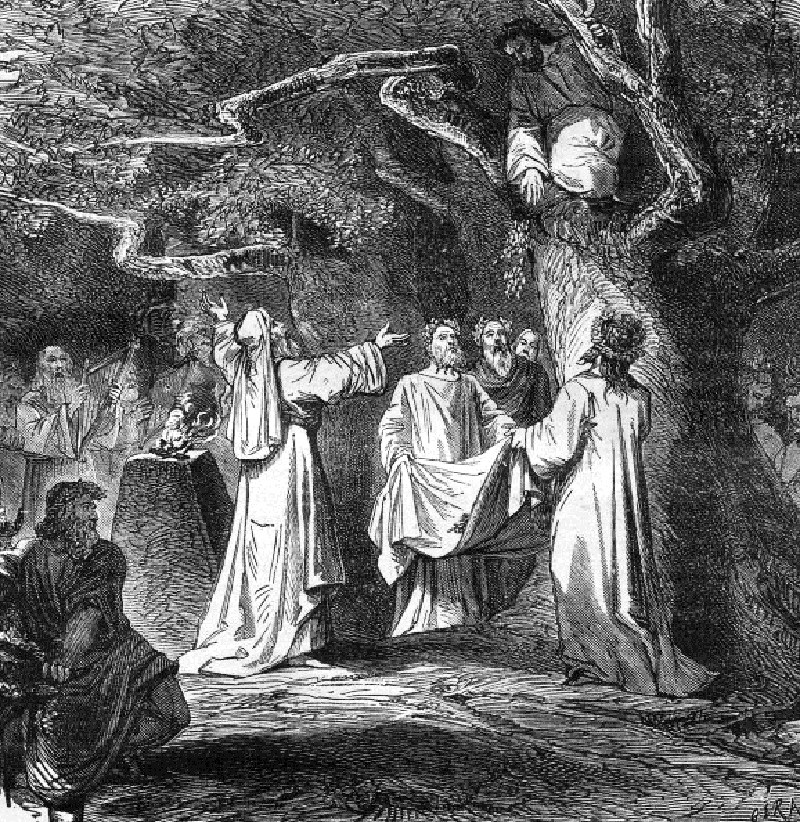
Pliny the Elder left us the most vivid account of the central Druidic rite: on the sixth day of the moon, a white-clad priest climbed the sacred oak with a golden sickle to harvest the mistletoe — held as the most sacred of plants precisely because it grew not in the earth but suspended between earth and sky, rooted in the oak itself. Two white bulls were consecrated and sacrificed, and the community feasted beneath the tree. The offering and the feast were not separate acts. Together they constituted a single gesture: a living conversation with the divine, conducted in the language of reciprocity.
The Voice of the Classical World
The Roman poet Lucan, writing in the first century CE, captured the atmosphere of the nemeton with a vividness that has never been surpassed. His description of a sacred grove near Massilia in the Pharsalia was designed partly to evoke dread in his Roman audience — but beneath the theatrical horror lies something genuine: an acknowledgment of the numinous that even a hostile observer could not dismiss.
Lucus erat longo numquam violatus ab aevo,
obscurum cingens conexis aera ramis
et gelidas alte summotis solibus umbras.“There was a grove, untouched through long ages,
enclosing the sky with interwoven branches,
and deep, cold shadows where the sun never reached.
No people came near in worship, for the gods themselves
held dominion there. At midday, when Phoebus stands at his zenith,
or when dark night envelops the heavens,
even the priest trembles to approach, fearing to see his god.”
The grove Lucan describes is a liminal space in the truest sense — a place where the veil between the human and the divine is not metaphorically thin but literally absent. The priest does not perform here from a position of comfortable authority. He approaches in awe, in trembling, and with the knowledge that what he might meet is beyond his control. This is not the religion of institutional comfort. It is the religion of genuine encounter.
The Sacred Oak: Axis, Ancestor, Memorial
At the heart of the nemeton stood the oak — and the oak was far more than a symbol. In the Celtic understanding, it was a living cosmological axis: its roots reaching into the underworld of the ancestors, its trunk standing in the world of the living, its branches stretching toward the heavens. It was the axis mundi made flesh in bark and leaf, grounding the three realms in a single living point.
The oak’s sacred status was inseparable from its role as an ancestral vessel. When a clan member died, the body was interred beneath the sacred tree, or the ashes scattered among its roots. Over generations this practice transformed the grove into something more than a place of worship — it became a living ossuary, a monument of accumulated lives, each new ring in the oak’s growth a testament to those who had gone before. The tree fed on the dead and gave back to the living; the living fed the tree with offerings and received from it protection, blessing, and the continued presence of those they had loved.
Sacred associations of the oak survived Christianisation in Ireland. St. Brigid’s monastic foundation was at Cill Dara — the church of the oak — and St. Colum Cille favoured Doire Calgaich, Calgach’s oak grove, which became the city of Derry. The new faith did not uproot the sacred tree. It planted its own roots beside it, and in time the two grew together.
The Céli Dé and the Living Grove
The inheritance of the nemeton did not end with the coming of Christianity to Ireland. It was carried forward — consciously, creatively, and with deep theological intentionality — by the Céli Dé, the Companions of God, whose communities flourished from the eighth century onward.
The Céli Dé were fully Christian in their faith and ascetic in their practice. Yet they retained the ancient Irish understanding that divinity is intimately present in the natural world, and that the sacred need not — perhaps cannot — be fully confined within walls of stone. Their monastic settlements often incorporated groves and designated outdoor spaces reminiscent of the old nemeta, where prayer, teaching, and communal practice could take place under the canopy of living trees. Sacred trees, stone markers, and earthwork enclosures served as loci for Christian liturgy, penitential practice, and the rhythms of the monastic day — echoing and transforming the earlier functions of the grove without simply replicating them.
It is worth noting that the relationship between the Céli Dé and their Druidic predecessors has been debated by scholars: the once-popular hypothesis that the Culdees were the direct Christian successors of the pagan Druids is now considered outdated. The continuity was real, but it was cultural and spiritual rather than institutional — a shared sensibility carried through the land, the people, and the accumulated memory of generations, rather than an unbroken organisational line.
What endured was a theological principle that neither Roman Christianity nor the pressures of institutional uniformity could fully erase: that the sacred is immanent, relational, and inseparable from the earth. That every venerable tree is a threshold. That the living and the dead are not separated by an uncrossable gulf but remain present to one another in the trembling of leaves, the turning of seasons, and the faithfulness of those who tend the grove.
The Grove as Cosmos
The nemeton was not a place set apart from ordinary life in order to be visited occasionally. It was the centre of ordinary life — the point from which everything else radiated outward and to which everything returned. Legal judgements, seasonal feasts, the burying of the dead, the initiation of the young, the consultation of omens, the reconciliation of disputes — all of these took place within or in relation to the sacred grove.
In this, the nemeton offers a model that retains its power across centuries. It is a model of a world in which the spiritual and the practical are not compartmentalised into Sunday and weekday, temple and marketplace, inner life and outer responsibility. They are one. The grove holds them all — and every rustle of the branches above the buried ancestors is a reminder that those who came before are still present, still listening, and still part of the living community of the clan.
The sacred is not elsewhere. It never was.
Sources
- Lucan, Pharsalia, Book III, lines 399–425.
- Pliny the Elder, Historia Naturalis, Book XVI.
- MacCulloch, J.A. (1911). The Religion of the Ancient Celts. T. & T. Clark.
- Green, Miranda (1986). The Gods of the Celts. Sutton Publishing.
- Koch, John T., ed. (2006). Celtic Culture: A Historical Encyclopedia. ABC-CLIO.
- Wikipedia: Nemeton, Llyn Cerrig Bach, Celtic Sacred Trees, Culdees.


Leave a Reply