A.D. Brock Adams
The Soul Does Not End
The Gaelic tradition has always known, with the quiet certainty of deep roots, that death is a threshold and not a wall. The soul that has lived through seasons of joy and grief, wisdom and error, love and loss — that soul does not simply cease. It crosses. It passes through the veil that thins at Samhain, when the western wind carries the scent of the otherworld and the ancestral fires are lit to guide the departing home.
The ancient Celts understood existence as a continuum — a river with many bends, not a cliff at whose edge the water falls away into nothing. In Gaelic and Brittonic mythology, the Otherworld is described as a supernatural realm of everlasting youth, beauty, health, abundance and joy — a place that exists alongside our own, elusive yet present, entered through burial mounds, sacred caves, the surface of still water, or the long westward passage across the sea toward the setting sun. This is not escape from the world but its completion — the world made fully itself, freed from the diminishments that shadow every mortal life.
The Names of the Otherworld
The Gaelic sacred imagination gave the Otherworld many names, each illuminating a different facet of the same vast mystery.
Tír na nÓg — the Land of the Young. Mag Mell — the Plain of Delight. Tír Tairngire — the Land of Promise, with its prophetic and messianic quality, a place of fulfillment that awaits the ready. Emain Ablach — the Isle of Apple Trees, realm of healing and restoration, the Irish heart of what the Arthurian tradition would remember as Avalon. Tír na mBeo — the Land of the Living, whose very name insists that what we call death is, in that country, recognised as the beginning of more abundant life.
Tech Duinn — the House of Donn, the dark god of the dead, whose rocky island stands off the southwest coast of Ireland — is the place where souls gather before their onward journey. A threshold between one existence and whatever follows — a place of transit rather than terminus. Even here, in the most austere of the Otherworld’s many chambers, the tradition affirms continuation. The soul rests at the House of Donn as a traveller rests at a waystation, before the road opens again toward the wider country of the dead.
The Otherworld is simultaneously the home of the gods, a destination for souls after death, and a realm accessible to living heroes through liminal gateways. Time moves differently there. Beauty is intensified. Death does not exist. The beings who inhabit it — the Tuatha Dé Danann and their descendants the daoine sìth — are the continuing presence of the divine within the landscape, guardians of a country whose borders are closer than the living ordinarily know.
Neamhní, Adharta, Saoirse: The Journey of the Soul
Beneath the mythological landscape of the Otherworld, the Barddas tradition offers the soul’s journey its cosmological framework — the three circles of existence through which every soul moves across the vast arc of its becoming.
Neamhní — Annwn — is the realm of primal existence: the stillness before becoming, the deep quiet in which the soul first stirs from the sleep of unmanifest potential. All animated existence begins in Annwn — the soul at its least, nearest to the absolute stillness of non-being, and from there begins its long ascent through every form of life toward the fullness of consciousness. This is not punishment or exile. It is genesis — the first breath of the fire that will in time become a sun.
Adharta — Abred — is the world we inhabit: the realm of trial, transformation, and the hard, beautiful, necessary work of becoming. Here the soul learns through experience what it cannot learn any other way — through suffering and joy, through failure and the grace that follows failure, through the ten thousand forms of love and loss that shape a being capable of bearing the weight of eternity. All living beings in Abred are on the return journey toward Gwynfyd — drawn by the gravity of divine love toward the freedom they have not yet reached but have always, in their deepest nature, known.
Saoirse — Gwynfyd — is the realm of radiant blessedness: the state in which the soul rests in conscious harmony with the divine will, free from the cycles of suffering and material entanglement, dwelling in the fullness of that light which it has been moving toward across the whole long arc of its existence. In the language of Hinduism this is Moksha — liberation. In the language of Buddhism it is Nirvana — the extinguishing of the fires of craving, the peace that passes understanding. In the language of Christianity it is the beatific vision — seeing God as God is, face to face, in the direct and unmediated light of love. The names differ. The country they describe is one.
And beyond even Saoirse turns Ceugant — the infinite circumference of God alone, which no creature can traverse, toward which all souls eternally orient themselves as flowers orient toward the sun: always approaching, never exhausted, forever drawn further into a mystery that deepens as it brightens.
The Ancestors Among the Living
The Gaelic vision of the afterlife has never consigned the dead to a distant realm sealed off from the living. The ancestors remain. They are woven into the landscape, present in the sacred trees above their resting places, in the rivers that carry the memory of their names, in the hills that bear the shapes their devotion carved across the centuries.
In ancient Ireland, this world and the world of the dead were understood as close neighbours — sometimes so close that the seam between them became invisible, and the living found themselves suddenly walking in both at once. At Samhain, that closeness intensifies to its annual peak, and the community gathers to honour what has always been true: that those who have passed are present, that love does not dissolve at death, and that the obligations of care and memory run in both directions across the veil.
This understanding resonates across traditions. In Shinto, the ancestors are not departed but transformed — present as kami of the household and the lineage, continuing to watch over their descendants from within the sacred fabric of the living world. In Christianity, the communion of saints affirms that the faithful departed remain alive in God, present to the Church in prayer, intercession, and the enduring power of holy memory. In Asatru, the honoured dead feast in the great halls of the gods, their deeds preserved in the eternal memory of the tradition, their courage flowing back through the bloodlines of their descendants like a river flowing always forward from its ancient source.
Each tradition holds a piece of the same truth: that death transforms but does not sever. That the bonds of love are stronger than the boundary between worlds. That the dead are not gone — they are ahead.
The Soul as Barque
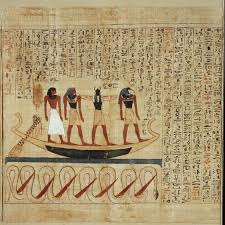
The soul, in the Gaelic understanding, is a barque upon the Sea of Eternity. It moves through many islands of existence, gathering at each landing the particular fruits of wisdom that only that island yields, carrying them forward into the next voyage. The sea is vast. The islands are many. Some landings are joyful and some are hard. But the direction of travel is always toward the far shore — what the tradition calls Harbour-home — where the soul at last comes to rest in the presence of God, its long voyaging complete, its cargo of hard-won wisdom laid at the feet of the One from whom it set out.
This is a vision of existence as evolutionary rather than judicial — not a single examination followed by eternal reward or eternal punishment, but an unfolding across time, in which every soul moves, at its own pace and through its own necessary experiences, toward the fullness that God has always intended for it. Evil is not permanent. Darkness is not final. The direction of all things is toward the light, and the light is patient enough to wait for every last soul to find its way home.
As W.B. Yeats, standing in the long memory of this tradition, once wrote of the Irish understanding: “In Ireland this world and the world we go to after death are not far apart… Indeed there are times when the worlds are so near together that it seems as if our earthly chattels were no more than the shadows of things beyond.”
The shadows point toward the substance. The substance is God.
The Unbroken Circle
The tradition of ArdNemeton holds the afterlife as the completion of what began in Neamhní — the first stirring of the soul in the primal depths — and what has continued through every lifetime, every grief, every moment of illumination, every returning to the roots of the clan tree. Death is the doorway between one phase of that journey and the next. The ancestors who have passed through it are not lost. They are further along the road, and they light it behind them for those who follow.
The feast does not end at the grave. It continues, in a country whose beauty makes every earthly loveliness look like a pale reflection — which it is. For the Otherworld is the original, and this world the echo; and the echo was made beautiful so that the soul might love its way toward the song.
All souls arise. All souls journey. All souls, in the fullness of time, come home.
References
- Iolo Morganwg (Edward Williams), Barddas, ed. J. Williams Ab Ithel (1862).
- Lebor Gabála Érenn, ed. R.A.S. MacAlister (1938–1956).
- The Voyage of Bran, trans. Kuno Meyer (1895).
- MacCulloch, J.A. (1911). The Religion of the Ancient Celts. T. & T. Clark.
- Rees, Alwyn and Brinley (1961). Celtic Heritage. Thames & Hudson.


Leave a Reply