Writer: AD Brock Adams
Baptism, Renewal, and the Cauldron of Welcome
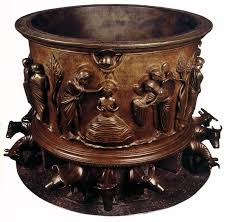
Within the Celi Dé tradition, baptism stands as the primary sacrament of initiation and renewal. More than a symbolic act, it is a conscious re-entry into covenant: a return to the living waters from which creation itself emerged. Water, long revered in both Christian and Celtic tradition as a sign of life, purification, and divine blessing, forms the heart of this rite.
Rather than being confined to a font within a church, baptism is ordinarily celebrated in living waters—rivers, lakes, springs, or the sea—affirming the sacredness of creation and recalling both the baptism of Christ in the Jordan and the ancient Jewish tradition of the mikveh. In Jewish practice, immersion in naturally gathered “living waters” served as a rite of purification, renewal, and preparation for sacred life. The baptism of Christ emerges from this broader sacramental understanding of water as a sign of spiritual transformation and covenantal relationship with God. By returning to living waters, the Celi Dé tradition seeks not only to imitate the historical circumstances of Christ’s baptism but also to reconnect with the deeper scriptural symbolism that underlies both Jewish and Christian practice.
The communal renewal of baptism is celebrated annually at Imbolg, the festival marking the first stirrings of spring and the awakening of life within the land. As winter loosens its grip and the earth begins its return to fruitfulness, the faithful enter the waters as a sign of spiritual renewal, repentance, and recommitment to the covenant. In doing so they participate in a cycle that is at once natural and theological: death and rebirth, dormancy and awakening, exile and return.
This observance exists in continuity with the ancient Christian commemoration of the Baptism of Christ at Theophany. While preserving the theological significance of the Lord’s baptism, the Celi Dé tradition situates its communal renewal within the seasonal rhythms that shaped the spiritual imagination of the Gaelic world. Thus the mystery of Christ’s baptism is not displaced but embodied anew within the landscape and seasons of the people.
The Eucharist remains the highest expression of sacramental communion and is reserved for the principal feasts of the liturgical year. Celebrated at Easter, Christmas, Pentecost, and other major solemnities, it serves as the visible sign of the unity of the people with Christ and with one another. Its relative rarity preserves its character as a sacred feast of covenant, thanksgiving, and divine hospitality.
Hospitality itself occupies a central place within the sacramental life of the community. Early Irish law regarded hospitality not merely as a virtue but as a sacred obligation. The Críth Gablach, Uraicecht Becc, Uraicecht na Ríar, and Cáin Aicill collectively affirm that rulers and householders alike were bound to provide food, shelter, welcome, and protection to those under their care. The legitimacy of a chief was measured not by his power to command but by his capacity to sustain the people through generosity and feasting. The renowned briugu, or hospitaller, could attain honour equal to or greater than that of local nobles through the faithful discharge of this duty.
Within the Celi Dé understanding, these ancient obligations find their fulfillment in Christ, who is both host and feast, giver and gift. The sacred community inherits the responsibility once borne by the chiefs and hospitallers of old. The nemeton therefore maintains what may be called the Cauldron of Welcome: a perpetual commitment that none who seek fellowship, nourishment, or refuge shall be turned away save those separated from the community through lawful discipline, and even these remain commended to the mercy and judgment of God.
In this way, sacrament and hospitality become inseparable realities. Baptism renews the covenant, the Eucharist nourishes it, and the communal feast embodies it. Together they express a distinctly Gaelic Christian vision in which divine grace is encountered not only through sacred rites but through the continual practice of generosity, fellowship, and care. The waters of renewal and the cauldron of welcome stand as twin signs of a people gathered in covenant with God and with one another.


Leave a Reply