A.D. Brock Adams
The Cosmic Birth
At the core of every primordial myth — every sacred birth narrative across the long memory of humanity — lies the mystery of manifestation: the emergence of form from formlessness, the ordering of chaos, the birthing of the Eternal into time. This is not merely a physical event but a metaphysical one, in which the foundations of the cosmos themselves arise into expression, and whose reverberations are felt through all being across the whole course of time.
In Druidic practice, the sacred sound IAO embodies the triadic nature of the creative Name and reflects the triangulated patterns of creation itself. Like the Hindu AUM, it is more than utterance — it is the vibrational signature of the cosmos, the resonance of the Absolute flowing into the relative, the One into the Many. This sacred vibration pulses and unfolds, reverberating through time and space. IAO is the echo of the divine birth, the reverberation of that primordial impulse as it takes form in the world. Creation, in this understanding, is an ongoing unfolding — a continual becoming whose beginning has no beginning and whose end is not yet spoken.
In the Barddas, the divine names are treated as mystical keys to the structure of reality itself: I signifies the First Cause, the ineffable source beyond all knowing; A marks the outpouring of divine will into manifestation, the breath that gives form; O denotes the return — the great cycle by which all creation flows back into unity with the One. Thus IAO embodies the eternal rhythm: origin, expression, and consummation held in a single living breath.
In Christian theology, this same reality is expressed as the Logos — the divine Word:
Anns an toiseach bha am Facal, agus bha am Facal maille ri Dia, agus b’ e Dia am Facal —
“In the beginning was the Word, and the Word was with God, and the Word was God.” (John 1:1)
The Word is the creative principle through which all things come into being. The Logos is Christ; and Brìghde — the brightness of inspiration — is its mother: the initiating desire by which the Word is spoken at all. Through this single unified act, all things are made manifest.
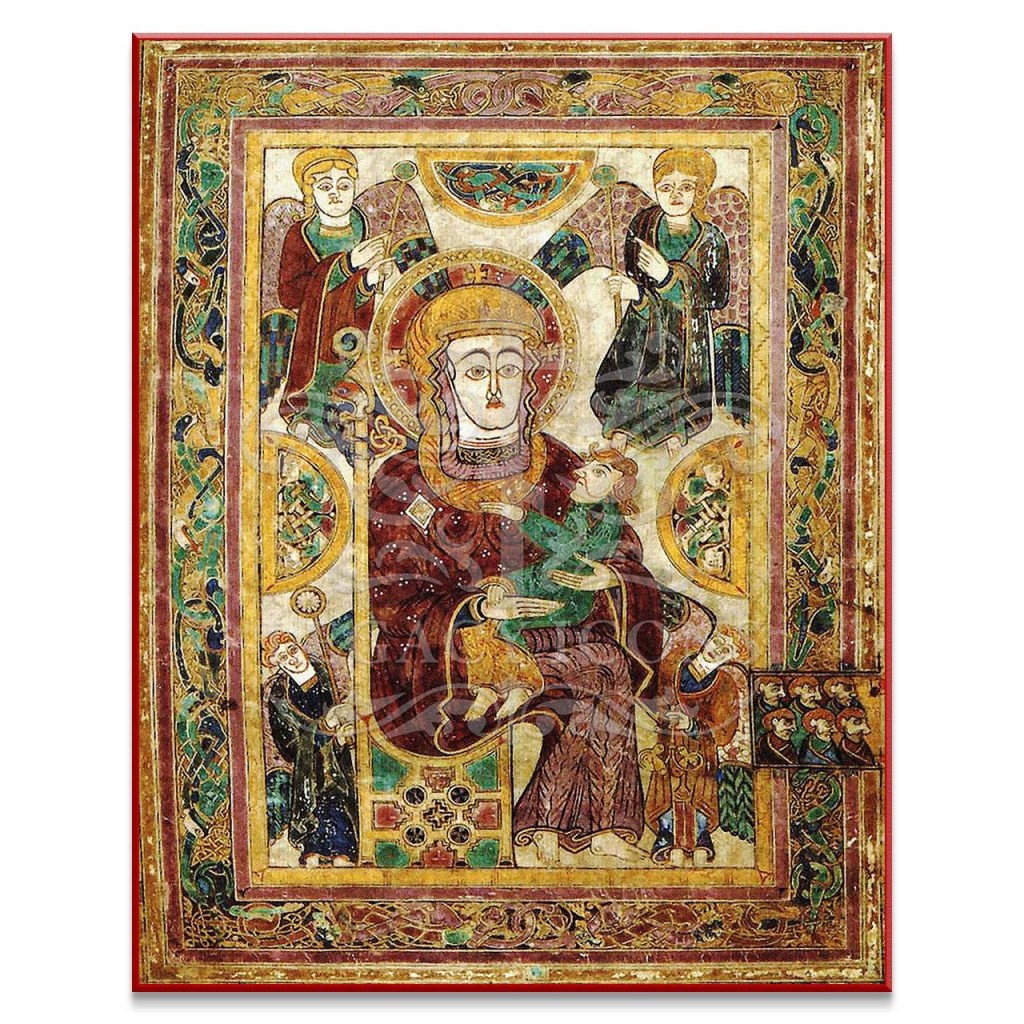
This Word enters history through the Incarnation of Jesus, born of the Virgin Mary, who is revered as the Theotokos — she who bore God in her womb. Mary is the vessel through which the divine enters creation, with Brìghde as her nurse-maid and illuminator. She is the womb of space and time, holding within herself the seed of all that is, that was, and that ever shall be.
The AUM of Hinduism, the Logos of Christianity, and the IAO of the Druidic tradition converge as vibrational signatures of the divine, reverberating through time and space as the essence of all being. Each affirms that creation is ever-renewing, ever-becoming. As Mary holds the Christ-child within her womb, embodying the sacred potential of all that is, so too does the cosmos hold within itself the ceaseless pulse of the divine — immanent within creation, transcending all form.
To name the Eternal is to gesture toward what exceeds all naming. The Logos, the AUM, the IAO — these are movements toward the Ineffable: the Word that is simultaneously beginning, middle, and end. Through their utterance, humanity gives voice to that primordial silence from which all sound, all being, and all becoming emerge. The divine reverberation continues eternally through the heart of creation, the timeless truth that all is One, and all is ever in the process of becoming.
The Big Bang and the Theotokos: The Womb of Creation
The modern scientific account of the Big Bang — the universe emerging from a singularity of infinite density and boundless energy, from which time, space, and all forms of matter and consciousness expanded into being — carries within it the same mystery the ancient cosmogonic myths have always carried. The moment of divine conception. The spark within the cosmic womb from which all creation arises.
As the womb of a mother holds the latent potential of life, so too did the singularity contain within itself the totality of existence. In the mythic and theological traditions surrounding the Theotokos — whether she is encountered as Mary, Isis, or D’Anu — the divine birth signifies far more than the arrival of a child. It proclaims the manifestation of the Divine Itself — the embodiment of all potential being. Such a birth is cosmological: an act of love so immense that it unfolds the very fabric of existence.
Within this unified cosmological and theological vision, the role of the Theotokos extends beyond the limits of earthly motherhood. She is the archetypal womb of all creation — the eternal vessel that receives, nurtures, and gives form to the divine spark from which the universe is born.
Cross-Cultural Reflections of the Divine Mother
The Divine Mother is the universal expression of creation emerging from the womb of the cosmos. Across the world’s traditions, she appears under many names, yet always bearing the same essence: the generative force that brings order from chaos, form from formlessness, and love from the deep silence of the void. She is the sustaining intelligence of creation itself — the matrix from which all being arises and to which all shall return.
In ancient Egypt, Isis is the mother of Horus, god of resurrection, renewal, and divine kingship. As protector and healer, she safeguards the light of continuity through her devotion, ensuring the restoration of balance and the triumph of life over death. As Mary nurtures the Christ who redeems and illuminates the world, Isis nurtures Horus, the restorer of divine order. Both embody the same mystery: the eternal mother’s love as the force through which the divine manifests within the world.
In Hinduism, Parvati — the embodiment of Shakti, divine creative power — is the wellspring of cosmic energy itself. She is the mother of Ganesh, remover of obstacles, who represents the capacity to overcome adversity with grace and discernment. His elephantine form carries the union of might and intellect, the same creative intelligence that in other traditions takes the form of the Logos, the Word, or the cosmic vibration of AUM. Druidic religious and philosophical teachings carry deep resonance with Vedic and Hindu beliefs — a resonance that the figure of the Divine Mother makes unmistakably visible.
In the Norse tradition, Frigg weaves the threads of destiny itself. Baldur — radiant god of light and beauty — mirrors the archetype of the divine child whose life and death renew the world. Freya, entwined with Frigg across the mythic memory of the North, carries another aspect of this same sacred feminine: love, fertility, and the ferocity of creation’s passion.
Across cultures and centuries, these myths carry one sacred story through countless forms: the eternal tale of the Divine Mother and her child, the birth of divine consciousness within creation. Whether she is named Mary, Isis, Parvati, D’Anu, Frigg, or Freya, she embodies the same truth — that creation is an act of love. The Divine Mother is the living expression of the cosmic Logos, the IAO, the AUM, the Word made flesh — forever giving birth to the universe through the pulse of compassion, wisdom, and divine will.
The birth of the divine child is a metaphysical principle: the ceaseless unfolding of the cosmos. Through her, the boundless becomes manifest. Through her, the eternal takes form. The Divine Mother is the womb of being itself — the ever-renewing heart of creation, beating through every age, every faith, and every soul that turns toward the light.
The Theotokos as the Bridge Between Worlds
The Theotokos is the eternal archetype of creation itself. She is the womb through which the eternal enters time, the threshold where the infinite becomes finite, the vessel of divine transformation. In her, the sacred and the material converge. She stands as the living bridge between heaven and earth, spirit and matter, the divine and the human.
Through Mary, Isis, Freya, and Parvati, we glimpse the same mystery — the cosmos as a divine womb containing all things, the infinite continually taking form within creation. As the universe emerges from the silence of the singularity, the divine emerges through the womb of the Theotokos, forever birthing light into the world.
The Sacred Mother in All Traditions
The birth of the divine — Horus from Isis, Ganesh from Parvati, Baldur from Frigg, Jesus from Mary — carries an unbroken mythological thread through the whole of human sacred memory. It is the birth of the cosmos. The manifestation of the divine presence that gives birth to life itself.
Through the Theotokos, the sacredness of the feminine principle is affirmed — not merely as biological function but as the divine container, the source of all that is, the origin of all creation.
To see the Theotokos as a universal archetype is to recognise the deeper cosmic truth that all these stories share: the vibration of the AUM, the Word of YHWH, the IAO, the cosmic birth — the egg in its breaking. The Theotokos is the mother of God and the mother of all things, and her womb is the space in which all creation is made manifest. Recognising this archetype across the traditions is the key to understanding the divine blueprint of creation itself — and to honouring, in every tongue and every time, the one sacred feminine through whom the eternal perpetually enters the world.


Leave a Reply