A.D. Brock Adams
The Original Face
Before there was Zeus, before there was Jupiter, before Odin hung upon the World Tree or the Dagda stirred his great cauldron — there was a single divine figure whose name echoed across the steppes of the ancient world and whose presence shaped the sacred imagination of every people who carried his memory westward, eastward, and into the remotest corners of Europe and Asia.
The ancestors of the Indo-European peoples looked up into the sky and saw a father — a cosmic patriarch with authority over the realm of daylight. They called him Dyēus Ph₂tēr — the Shining Father, the Sky Father — the reconstructed name of the daylight-sky god in Proto-Indo-European mythology, conceived as a divine personification of the bright sky and the seat of the gods.
The name Dyēus comes from a PIE root meaning “to shine,” suggesting a strong connection with daylight and the daytime sky. From this single ancient root, the great father-figures of the Indo-European world descended like rivers from a mountain source: Zeus among the Greeks, Jupiter among the Romans, Dyaus Pita among the Indo-Aryans, Dievas among the Baltic peoples, Deuos among the Celts. Each people carried the original figure into their own landscape, their own history, their own particular encounter with the sacred — and in doing so, shaped him into someone new while preserving something irreducibly ancient.
Two of the most powerful and most revealing of these transformations are Odin Alfaðir of the Norse and Eochaid Ollathair — the Dagda — of the Gaels. Separated by sea and language, shaped by radically different mythological climates, they nonetheless carry within them the unmistakable imprint of a shared origin: the same cosmic father, known by different names, wearing different masks, serving the same primordial function.
Odin Alfaðir: The All-Father of the Norse
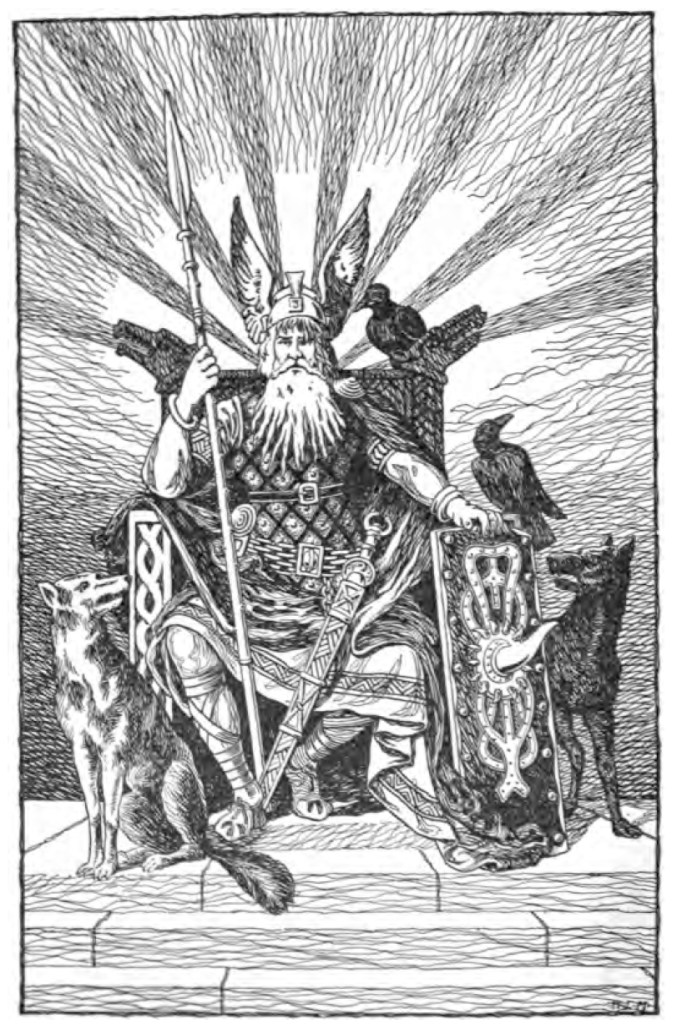
In the Norse sacred tradition, Odin bears the title Alfaðir — the All-Father — and the weight of that title reaches back through millennia of accumulated mythological memory. He is the patriarch of the Æsir, the shaper of the cosmos from the body of the primordial giant Ymir, the one who breathed life into the first human beings, Ask and Embla, when he and his brothers Vili and Vé found them lifeless on the shore of the new world.
Odin’s wisdom is purchased at incalculable cost. He surrenders an eye to Mímir’s well for the knowledge that sees beneath the surface of all things. He hangs himself upon the World Tree Yggdrasil — the great cosmic axis that binds the nine realms — for nine days and nine nights, wounded by his own spear, in order to wrest the secret of the runes from the depths of the void. These are acts of sacrifice in the most primal sense: the willingness to lose something irreplaceable in order to gain something that transcends personal wholeness. The All-Father wounds himself for wisdom because wisdom is more essential to his nature than comfort, sight, or even his own life.
As a sky father, Odin connects to Dyēus Ph₂tēr through his role as both creator and lawgiver — the protector and progenitor of humankind, ruler of the divine realm. But Odin is also something the original PIE sky father was perhaps not: a god of the margins, a wanderer, a master of shape and disguise who moves through the worlds of gods and men in the grey cloak of an old traveller, one-eyed and staff-bearing, watching and learning. He is the god who goes out into the darkness to understand it — who descends into the realm of the dead to consult the völva, the seeress, about the fate of the cosmos. The wisdom he seeks is not comfortable. It is the wisdom of endings as well as beginnings, of Ragnarök as well as creation.
His eight-legged horse Sleipnir — born of the trickster Loki in the shape of a mare — traverses all nine realms with equal ease, carrying Odin between the living and the dead as readily as between waking and dreaming. The horse in Indo-European sacred tradition is consistently the symbol of sovereignty and the capacity to move between realms — a theme that will return when we come to Eochaid.
Eochaid Ollathair: The Dagda of the Gaels
Across the sea, in the sacred memory of the Gaels, the same cosmic figure wears a very different face — and the contrast is as illuminating as the resemblance.
Eochaid Ollathair — the Dagda, the Good God — is the great father of the Tuatha Dé Danann. His epithet Ollathair, meaning All-Father or Great Father, is the direct Gaelic echo of Odin’s Alfaðir: the same title carried across the linguistic divide that separates the Norse and Gaelic branches of the Indo-European family. Both descend from the reconstructed PIE *Dyḗws Ph₂tḗr — the daylight sky father, chief deity of the Proto-Indo-European pantheon.
Where Odin is austere, solitary, and marked by sacrifice, the Dagda is abundant, earthy, and thunderously alive. He carries a club of such power that one end deals death and the other restores life — sovereignty over the boundary between existence and non-existence, wielded not with solemnity but with the casual authority of one who has held the keys to that boundary since before time began. His cauldron of plenty — Coire Ansic, the Undry — feeds all who come to it and is never emptied: the inexhaustible generosity of the divine father made visible in a vessel of bronze, nourishing gods and mortals alike without distinction or diminishment.
His name, Eochaid, means horseman — the horse-rider, the one who commands the sovereign beast. The Sky Father in PIE tradition was intimately associated with horses — a connection that persisted across all branches of the Indo-European world, from the Vedic Ashvins to the Gaulish Epona, from Odin’s Sleipnir to the ancient Irish Feis Temhro, the sacred rite of royal inauguration in which the king entered into a ritual relationship with the sovereignty of the land through the medium of the horse. Eochaid’s very name carries that ancient association: the father of the gods is also the master of the sovereign animal, the one whose authority over the land is expressed through his command of the creature most sacred to the Indo-European understanding of power.
Like Odin, the Dagda is a god of wisdom — but his wisdom is worn differently. Where Odin’s knowledge is hard-won through pain and self-annihilation, the Dagda’s seems to flow naturally from his sheer vastness, his enormous appetite for life in all its forms. He eats from a cauldron so large it requires a ladle the size of a man and a half. He makes love with extravagant and unselfconscious abandon. He dresses badly and moves through the world without concealment or disguise. He is the opposite of Odin in manner and yet identical in essence: both are the cosmic father who holds the power over life and death, both are the wise and ancient one whose knowledge shapes the destinies of gods and mortals, both are the inexhaustible source from which the divine lineage descends.
One River, Many Names
The family resemblance between Odin and the Dagda is the family resemblance of cousins who have not met in generations — who have each grown into their respective landscapes, absorbed their respective climates, and developed their own particular characters — but who share, unmistakably, the same bone structure.
As the pantheons of individual mythologies evolved, the attributes of Dyēus were redistributed and transformed — He became Zeus among the Greeks, Thor and Tyr for the Norse, Dies Piter with the Romans, Dyaus Pita for the Indians. Among the Norse, the shining sky father evolved toward the dark wisdom-seeker — perhaps shaped by the long winters, the harsh seas, the Viking culture’s intimate relationship with death and fate. Among the Gaels, the same figure evolved toward abundance, generativity, and the sacred relationship between the divine father and the fertile earth — perhaps shaped by the green and generous island that formed the Gaelic world’s sacred geography.
Both are true. Both are complete expressions of what the original figure contained. The sky father is both the cold clarity of the winter sky and the warmth of the summer sun. He is both the wisdom that is purchased through suffering and the abundance that overflows without effort. He is both the wanderer in grey who watches from the margins and the great jovial lord of the feast whose cauldron never empties.
Many Indo-European pantheons contain sky gods that hold pre-eminence among the others — and in each case that sky god carries, in his own particular form, the memory of the original shining father who stood at the centre of the oldest human understanding of the divine: a cosmic patriarch whose sovereignty over the heavens mirrored and guaranteed the social order below, whose wisdom illuminated the world, whose generativity sustained all life, and whose name — in all its many forms across all its many languages — always meant the same thing.
Father. Light. Sky. Source.
References
- Poetic Edda, trans. Carolyne Larrington (1996). Oxford University Press.
- Lebor Gabála Érenn, ed. R.A.S. MacAlister (1938–1956). Irish Texts Society.
- Mallory, J.P. and Adams, D.Q. (2006). The Oxford Introduction to Proto-Indo-European and the Proto-Indo-European World. Oxford University Press.
- West, M.L. (2007). Indo-European Poetry and Myth. Oxford University Press.
- Mac Cana, Proinsias (1970). Celtic Mythology. Hamlyn.


Leave a Reply