A.D. Brock Adams
What the Nemeton Is
The nemeton is the sacred heart of Druidic spiritual life. Its name descends from the Proto-Indo-European root nemos — sacrifice, worship, sacred clearing — and it carries within it the full weight of what that means: a place set apart, deliberately and reverently, where the worlds of the human, the ancestral, and the divine are understood to converge.
Nemetona — she of the sacred grove — presides over these spaces as their divine guardian, her name inscribed on votive offerings from the Rhine to the hot springs of Bath, from the tribal territories of Gaul to the windswept coasts of Britain. Wherever the Gaelic and Celtic peoples carried their spiritual understanding, the nemeton went with them. Toponyms rooted in nemeton occur as far west as Galicia in the Iberian peninsula, as far north as Scotland, and as far east as central Turkey — testimony to a sacred concept as old as the people themselves.
The nemeton is first and foremost a grove: an open-air sacred space under the sky. To worship beneath a roof is to impose a ceiling on the infinite. The Druidic understanding has always been that the divine is most fully present in the living world — in tree and stone, in the turning of seasons, in the breath of wind through old growth oak. To build walls around that presence is not to honour it but to diminish it.
The Form of the Grove
No two nemeta were identical, but the sacred pattern recurring across the tradition is consistent in its essential elements. At the centre stands the great tree — most often the oak, sometimes the ash or yew — whose roots reach into the world of the ancestors and whose crown extends toward the heavens. This is the axis mundi made living: the point where all three realms — below, here, and above — are gathered into one.
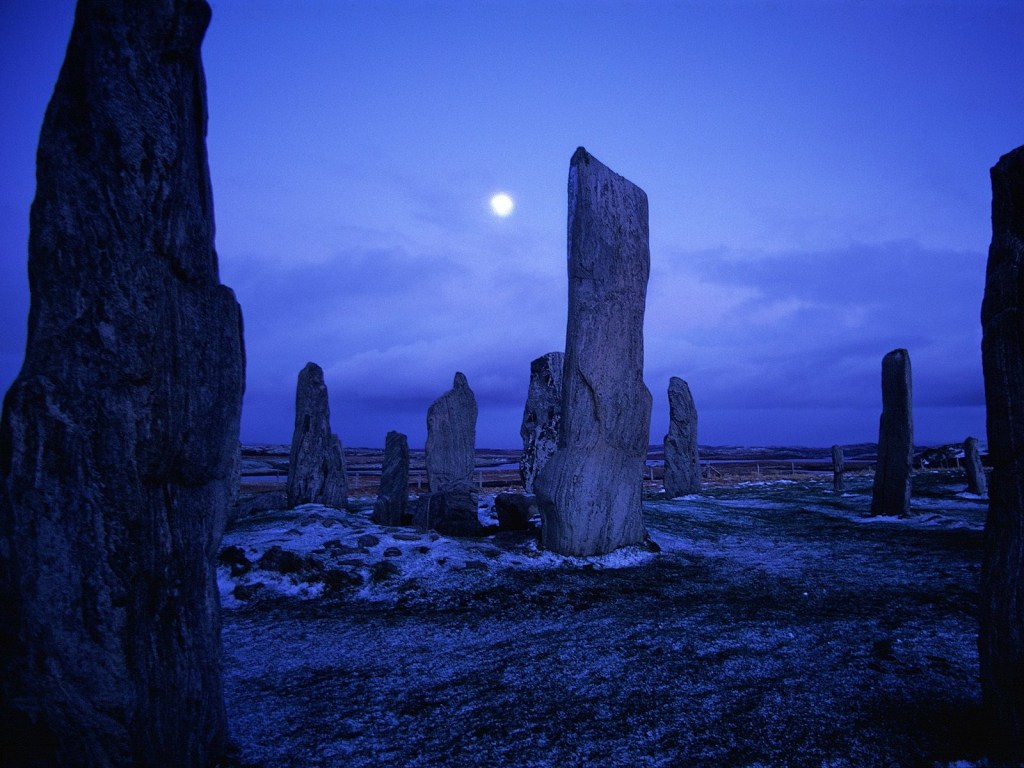
Around the central tree, rings of standing stones, earthwork embankments, and ditched enclosures demarcate the boundary between the sacred and the ordinary. These boundaries are not merely symbolic. They are functional, marking the threshold between one mode of being and another. The embankments were sometimes terraced, allowing the wider community to witness from a respectful distance what the initiated performed at the centre. The sacred boundary was not a wall of exclusion but a membrane of preparation — a reminder that what lay within required a different quality of attention and presence than the world outside.
Individual trees were held as sacred by local communities, and tribal gatherings were often held under their shade. At what were once such sacred areas, votive plaques from the Gallo-Roman period bear dedications to the gods of specific tree species — Fagus for beech, Robur for oak, and others whose names have not yet been recovered. The sacred grove was not a generic natural space. It was a carefully tended, consecrated landscape, chosen and shaped over generations to serve as the community’s permanent meeting point with the divine.
The functions of the nemeton were never divided into the separate categories a modern mind might expect. Prayer, sacrifice, feasting, legal tribunal, divination, the honouring of ancestors, the initiation of the young, the burial of the dead — all of these took place in the same space, because in the Gaelic understanding they were never separate activities. The sacred and the civic were one. The spiritual and the practical were expressions of the same underlying reality.
The Goddess of the Grove
Nemetona is a Celtic goddess with roots in northeastern Gaul, thought to have been the presiding deity of the Nemetes people. Evidence of her veneration runs from the Middle Rhine through the sacred precincts of Trier, and she appears alongside Loucetius Mars on altars at Bath — a pairing that speaks to her role as guardian of both the sacred space and the warrior community gathered within it.
Arnemetia — she who dwells before the sanctuary — is another face of this same presence, her name preserved in the Romano-British healing springs of Aqua Arnemetiae. The remarkable longevity of the nemeton concept across languages, cultures, and centuries indicates that its spatial and spiritual symbolism was among the most significant in early Celtic culture — and that it carried meaning deep enough to survive the transition into the Christian period, with pre-existing nemeton sites being Christianised and new nemeton place-names coined with Christian significance. The sacred grove did not disappear. It transformed, carrying its essential character forward into new expressions of the same fundamental understanding.
The Oak as Ancestor, Axis, and Living Memorial
The oak at the heart of the nemeton is not merely a large tree. It is a living cosmological statement.
The oak features prominently across Celtic cultures. The ancient geographer Strabo reported that the great sacred grove and assembly place of the Galatian Celts of Asia Minor — Drunemeton, the Oak Sanctuary — was filled with oaks. Pliny the Elder describes the Druidic festival of the sixth day of the moon, when priests climbed the sacred oak to harvest mistletoe and consecrate two white bulls in a rite of fertility and communion.
This was not superstition. It was a coherent theology of relationship. The oak stood as the clan’s living memorial: its roots holding the remains of the dead, its trunk standing in the world of the living, its branches reaching toward the divine. Every generation buried at its feet became part of the tree’s life. Every new ring in the wood was the growth of the lineage itself — the dead nourishing the living, the living tending the dead, the boundary between them rendered permeable by the very grain of the wood.
To stand beneath the clan oak at ceremony was therefore to stand in the presence of all who had stood there before. The ancestors were not remembered in the abstract. They were present — in the roots, in the canopy, in the hum that moves through very old wood on a still day. Every offering made at the base of the tree was received by the living and the dead simultaneously, because the tree held them both.
Lucan’s Grove
The Roman poet Lucan, writing in the first century CE, described a nemeton near Massilia with the particular horror of someone encountering a sacred power his own tradition could not fully contain:
Lucus erat longo numquam violatus ab aevo,
obscurum cingens conexis aera ramis
et gelidas alte summotis solibus umbras.“There was a grove, untouched through long ages,
enclosing the sky with interwoven branches,
and deep, cold shadows where the sun never reached.
No people came near in worship, for the gods themselves
held dominion there. At midday, when Phoebus stands at his zenith,
or when dark night envelops the heavens,
even the priest trembles to approach, fearing to see his god.”
Beneath the theatrical dread, Lucan witnesses something genuine: a space so saturated with sacred presence that even its own custodian approaches it in awe. This is the nemeton as it was meant to be — not a comfortable venue for managed religion, but a living threshold where the encounter with the divine was real enough to be frightening. The priest trembles not from superstition but from the honest recognition of what he is walking into.
The Druids as Custodians
The Druids were the hereditary custodians of the nemeton — its priests, its judges, its physicians, its poets, and its mediators between the living and the dead. They tended the sacred oak, performed the offerings at its roots, read the omens that rose from the grove’s silences, and spoke the needs of the living community into the listening presence of the ancestral and divine.
Their role was not ceremonial in the modern sense of the word — not a performance of inherited gestures. It was active mediation: standing in the doorway between worlds and keeping it open. The Arch-Druid who climbed the oak to harvest mistletoe at the sixth moon was not acting out a tradition. He was fulfilling a living obligation to the community, the ancestors, and the gods, all of whom had a stake in what was about to happen beneath the great tree.
The Céli Dé: Continuity Through Transformation
The understanding that the divine is most fully encountered in the living world did not end when Christianity arrived in Ireland. It was carried forward — consciously and with great theological care — by the Céli Dé, the Companions of God.
The Céli Dé established their monastic communities in landscapes that breathed the same sacred geography as the old nemeta: beside rivers and springs, within groves, on hilltops open to the sky. Their liturgical observances moved with the seasonal calendar. Their outdoor spaces served the same multiple functions — prayer, teaching, penitential practice, communal gathering — that the sacred grove had always served.
This was not nostalgia for a discarded past. It was the recognition that the sacred does not relocate when a tradition changes. The land remains what it is. The ancestors remain where they are buried. The great tree continues to grow. What changes is the language in which the same encounter is named and celebrated. The Céli Dé understood that to abandon the sacred landscape of Ireland in favour of an imported architecture of stone and enclosure was to sever the community from the very ground of its spiritual life.
They chose continuity instead — and in doing so, preserved something of irreplaceable value.
The Living Grove
The nemeton is not a historical curiosity. It is a living model of what it means to inhabit a sacred world.
It is a world in which the dead are present among the living, nourishing the community from beneath the roots of the clan tree. In which the seasons are not merely meteorological events but sacred thresholds requiring acknowledgement and ceremony. In which justice and worship, feasting and prayer, governance and sacrifice are not separate departments of life but expressions of a single sacred order.
Every rustle of the branches is the voice of those who came before. Every offering laid at the roots is received by the living and the dead alike. Every gathering beneath the canopy is attended by all who have ever gathered there — and by the presence that underlies them all.
The grove must be tended. The fire must be kept. The names must be spoken aloud, season after season, until the speaking itself becomes the prayer.
Sources
- Lucan. Pharsalia, Book III.
- Pliny the Elder. Historia Naturalis, Book XVI.
- Strabo. Geographica, Book IV.
- MacCulloch, J.A. (1911). The Religion of the Ancient Celts. T. & T. Clark.
- Green, Miranda (1992). Dictionary of Celtic Myth and Legend. Thames & Hudson.


Leave a Reply