A.D. Brock Adams
The Sacred Three
Before there was a doctrine, there was a number. The number three has occupied the deepest register of Celtic sacred imagination since long before Christianity arrived on Irish shores — present in the triple spiral carved into the great passage tomb of Newgrange five thousand years ago, woven through the bardic tradition’s compulsive tendency to formulate wisdom in triads, and embodied in the three-faced heads of Gaulish sacred art that stare simultaneously in all directions at once.
The resonant symbolism of three runs through Celtic tradition from the earliest times. Pythagoras recognized three as the perfect number, signalling beginning, middle, and end. Three can represent life: male, female, and progeny; time: past, present, and future; the visible world: sky, earth, and underground. A full account of Celtic instances of triplism would fill many pages, coming from all periods of Celtic culture.
The triskel — a figure composed of three spirals — signifies the three-layered nature of the human soul, and is a central figure in ancient Celtic symbolism. The earth, sea, and sky share a threefold marriage in oaths and as witness to sacred deeds. Land, Sea, and Sky is the most foundational of Celtic triads — the Land as the bones of the ancestors, the domain of sovereignty; the Sea as the realm of the deep, the source of wisdom and the boundary of the known world; the Sky as the realm of breath, inspiration, and divine guidance. Many modern Celtic Pagans and Druids honour this by opening rituals with invocations to all three realms.
Brigid, in many tellings, is three sisters sharing a single name — poetess, smith, and healer — each a master of one of the three skills most vital to the people of Éire. In Irish mythology the main trinity of sovereignty was that of Ériu, Banba, and Fódla — the three goddesses of the land of Ireland itself. The Roman poet Lucan proposed that the Gaulish gods Esus, Taranis, and Teutates were mentioned so often together as to form a triad. In early Ireland: the three sons of the Dagda, the three Fothads, the three gods of craft — Credne, Goibniu, and Luchta.
The number three is not a doctrine in the Celtic tradition. It is a perception — a recognition that reality, at its deepest level, tends toward threefold expression: one force in tension with another, and the third force that holds, transforms, or resolves them.
The Triquetra: Where the Ancient and the Christian Met
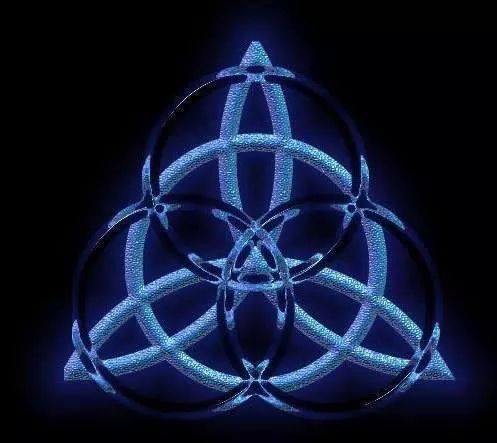
The triquetra — the Celtic trinity knot — was incorporated into Christian iconography by Irish monks, particularly evident in the Book of Kells from the ninth century, as a symbol for the Holy Trinity: Father, Son, and Holy Spirit — one God revealed in three persons.
The ease with which the Celtic tradition received this symbol is not coincidental. The Christian doctrine of the Trinity — three persons in one divine nature, distinct yet inseparable, each fully God yet not three Gods — resonated with a sacred imagination already thoroughly at home with the principle of threefold divine unity. Patrick’s famous use of the shamrock to explain the Trinity to the Irish was not, in this light, merely a clever pedagogical device. It was a recognition that the ground had been prepared — that the Irish already understood, in their bones and their bardic tradition, that the One could express itself in three without ceasing to be One.
The Trinity of Christian theology brought a name and a revealed face to what the Gaelic tradition had long known as a principle: that the divine life is relational, that unity and diversity coexist at the heart of God, and that the sacred tends toward threeness in all its most fundamental expressions.
The Trinity Across Traditions
The threefold divine principle appears wherever humanity has looked most deeply into the nature of sacred reality.
In Hinduism, the Trimurti — Brahma the creator, Vishnu the sustainer, Shiva the transformer — embodies the three fundamental movements of existence: origination, preservation, and dissolution. These are not three separate gods but three modes of the one divine reality, each necessary, none sufficient alone. The IAO of the Druidic tradition — I for the First Cause, A for the outpouring into manifestation, O for the return — traces the same triadic movement in vibrational rather than personal form: the One breathing out, dwelling in expression, and breathing back.
In Norse tradition, the great triad of Odin, Freya, and Thor embodies the three fundamental domains of sacred life: wisdom and sovereignty, love and generativity, strength and protection. In Greek tradition, Hecate stands at the triple crossroads — maiden, mother, crone — guardian of thresholds, present simultaneously in three directions. In Zoroastrian theology, the three sacred qualities of Humata, Hukhta, Hvarshta — good thought, good word, good deed — constitute the complete expression of the righteous life, the trinitarian structure of ethical being.
Each of these is a genuine perception of something real about the structure of the divine. The tradition of ArdNemeton honours them all as Thaisbeanaidhean — showings of the one sacred reality through the particular forms available to each people and each age.
The IAO and the Physics of the Divine
The Druidic triadic formula IAO — preserved in the Barddas and echoing through the Hermetic and Pythagorean traditions that influenced the ancient world alongside the Druidic — offers a way of understanding the Trinity that speaks with particular force to the contemporary mind.
I — the First Cause, the ineffable source beyond all knowing, the uncaused cause from which all being proceeds. A — the outpouring of divine will into manifestation, the breath that gives form to the formless, the creative Word spoken into the void. O — the return, the great cycle by which all creation flows back into unity with the One from whom it came.
The tradition also invites a reading of the Trinity in relationship to the fundamental forces that govern physical reality. Our tradition frames it boldly: “out of nothing, the creator of the worlds produced three elements as root materials and prior causes for all creation, joined in harmony.” Gravity — the force of attraction, of things drawing toward one another, of mass calling to mass across the void — speaks of the Father, the ground of all being toward whom all things tend. Electromagnetism — the force of light, of energy, of the fire that illuminates and the warmth that sustains — speaks of the Son, the Logos made visible, the divine fire entering the world. The nuclear forces — the power binding at the heart of matter itself, holding together what would otherwise fly apart — speak of the Spirit, the indwelling presence that sustains the coherence of all things from within.
This is not a claim that physics and theology are the same discipline. It is the recognition that the same divine intelligence that structured the sacred order of the cosmos has left its triadic signature throughout the fabric of physical reality — and that those who look at the world with the eyes of faith and the eyes of science are, at sufficient depth, looking at the same thing.
The highest being — known as God, Dia, Jah, Krishna, AUM, Hu, IAO — is the one source from whom all three fundamental modes of existence proceed. The names differ. The three always appear together. The unity is never broken.
The Threefold Oath
In the Gaelic tradition, the most sacred oaths were sworn by the three elements: by the Land, the Sea, and the Sky — by the earth beneath my feet, the water around my shores, and the sky above my head. This threefold witness invoked the whole of creation as guarantor of the promise. It placed the person making the oath within the total sacred order of the world, accountable to all three realms simultaneously.
It is, in its own way, a Trinitarian act: the acknowledgement that the divine presence that holds one accountable is not a single point of authority but a relational field encompassing all of existence — above, below, and surrounding; past, present, and future; creator, sustainer, and transformer.
The triple spiral pattern found on Newgrange, the triple goddess of sovereignty, the threefold death in mythology — the number three continues to be an integral part of Irish identity and culture, its importance evident in the literature of medieval Ireland, which abounds in triplets and triads.
The Trinity, in Celtic Western Orthodoxy, is not a foreign doctrine imported from the Mediterranean. It is the ancient indigenous perception of the Gaelic sacred imagination, confirmed and named by the Gospel, expressed in the triquetra of the illuminated manuscripts, sworn by in the oldest oaths of the land — and still present, for those who look, in the three spirals carved by unknown hands into the stone above the dead at the heart of the Boyne Valley, five thousand years before the Word was spoken in Galilee.
References
- Trecheng Breth Féne (Triads of Ireland), 9th century.
- Iolo Morganwg (Edward Williams), Barddas, ed. J. Williams Ab Ithel (1862).
- Carmichael, Alexander (1900). Carmina Gadelica. T. & T. Clark.
- Mac Cana, Proinsias (1970). Celtic Mythology. Hamlyn.
- Newell, J. Philip (1997). Listening for the Heartbeat of God. SPCK.


Leave a Reply