A.D. Brock Adams
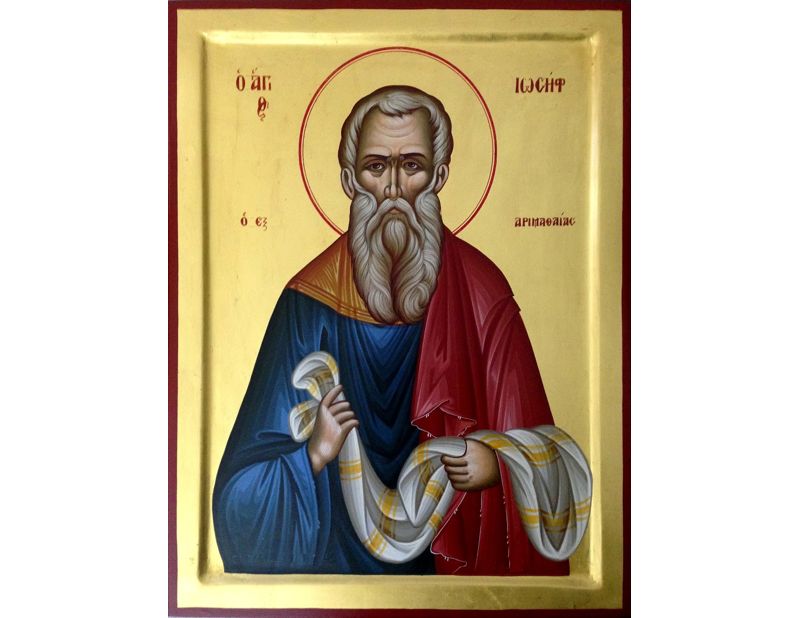
Joseph of Arimathea: Custodian of the Sacred Vessel
The earliest layer of the Western Orthodox mythos begins not with empire but with exile. In the Gospel of Matthew, Joseph of Arimathea appears as the wealthy disciple who offered his own prepared tomb for the body of Christ — a single act of extraordinary courage and love, performed at the moment of maximum danger, when to associate openly with the crucified Jesus was to invite the same fate. He appears, performs his act of sacred custody, and withdraws from the canonical narrative as quietly as he entered it.
It is in that withdrawal that the legend begins.
The most influential legends about Joseph developed in the medieval period, combining Christian devotion, Celtic myth, and chivalric ideals. Among the earliest is the claim preserved in William of Malmesbury’s De Antiquitate Glastoniensis Ecclesiae that Joseph travelled to Britain and founded a church at Glastonbury, Somerset — a claim that, though attributed to popular tradition, became widely accepted across England. According to this tradition, Philip sent twelve disciples into Britain to teach the word of life, appointing as their leader his very dear friend Joseph of Arimathea, who had buried the Lord. They came to Britain in AD 63.
The Glastonbury legend eventually held that Joseph brought two cruets containing the blood and sweat of Christ to Britain, and planted a staff that miraculously bloomed into the Glastonbury Thorn. The staff takes root. The vessel is preserved. The mystery is carried westward across the sea.
The symbolism of the Grail is manifold and inexhaustible. A cup that bears blood becomes a chalice of medicine for the whole world. A carpenter’s guild becomes a fellowship of sanctified labour. The migration of relics becomes the migration of mysteries. In mytho-theological terms, Joseph’s westward journey represents the translation of the Gospel from the Semitic East into the Celtic West — a pouring of the divine light toward the setting sun, toward the islands at the edge of the known world, toward the sacred geography that the Gaelic tradition had always understood as the threshold between the mortal realm and the eternal.
To venerate Joseph is not to affirm a travel itinerary. It is to acknowledge the principle of sacred custodianship — the keeping of mysteries in trust across generations, the willingness of the faithful to carry the vessel into unknown territory and protect what has been entrusted to them until the time is right for it to be opened. Every tradition that has survived suppression, diaspora, and the long pressures of history knows this office intimately. Joseph is its patron.
Glastonbury: The Threshold of the Isles
Glastonbury occupies a liminal place in the sacred memory of the West: neither wholly myth nor wholly fact, but always more than either alone. Joseph of Arimathea is important in establishing the connection to Glastonbury’s Celtic origins — the belief that Joseph founded a church of British Christianity that predated the Roman mission to England, which began in 597 CE.
There is the 7th century Glastonbury Abbey, an Iron Age lake village a few miles to the northwest, and links with King Arthur and the Holy Grail. Tradition states that an older Celtic Christian church of wattle and daub stood on the site before the Abbey — the vetusta ecclesia, the ancient church, described by William of Malmesbury as the oldest in Britain and as having been founded perhaps by disciples of Christ or the earliest of his followers.
The Glastonbury Thorn — the hawthorn that blooms at Midwinter as well as in spring, whose flowering branch is still brought to the British monarch at Christmas — is one of those sacred objects that exist at the intersection of myth and living practice: whether its particular history is precisely as the legend tells it matters less than what it means. A staff thrust into foreign soil and taking root. The pilgrim becoming part of the new land. The sacred presence carried from the East finding its expression in the specific vegetation of the West.
Glastonbury stands as the symbolic threshold of the Isles — a convergence point where Eastern apostolic streams, Celtic Druidic sanctity, and the sacred landscape of southwestern Britain interwove into something that cannot be fully categorised as either one tradition or another. It is a place where the categories dissolve, as they do at all genuine thresholds. What it offers the tradition of ArdNemeton is the image of the sacred carried westward across great distances and planted in new soil — where it takes root differently than before, flowers at unexpected times, and continues to nourish those who come to it in the spirit of pilgrimage rather than the spirit of tourism.
William Blake: The Prophetic Bard of the Western Path
If Joseph is the custodian of mysteries and Glastonbury the threshold of arrival, then William Blake — poet, engraver, visionary, and for a period Chief Druid of the Order of Bards, Ovates, and Druids — is their prophetic bard: the one who gave the Western Orthodox imagination its most searing and most enduring poetic expression.
Blake’s poem “And did those feet in ancient time” — written in 1804 as the preface to his epic Milton: A Poem in Two Books — is often assumed to have been inspired by the apocryphal story that Jesus, in the unknown years before his ministry, visited what is now England, accompanied by Joseph of Arimathea. Blake blends visionary mysticism and social critique, then shifts to militant prophetic rhetoric: summoning mythical weapons and vowing unceasing spiritual struggle to build Jerusalem in England — expressing a desire for moral and communal redemption.
The poem asks four questions and answers none of them. Did those feet walk upon England’s mountains green? Was the holy Lamb of God seen on England’s pleasant pastures? Did the Countenance Divine shine forth upon the clouded hills? Was Jerusalem builded here among the dark Satanic Mills?
The questions are the answer. Blake understood that the presence of the sacred in a landscape is not established by historical proof but by the quality of attention brought to the question. The person who asks did God walk here? with genuine longing and genuine willingness to be transformed by the answer has already begun to build the Jerusalem they are seeking. Blake seemed to equate the human imagination with a Christian vision — he created an entire alternate mythological universe, and yet he believed in the essence, as he understood it, of Christianity.
His call to arms is not a call to violence but to mental fight — the refusal to accept the world as it is when the world as it should be remains visible to the imagination. For Blake, Jerusalem represents the perfect community: no discord, equality, a utopia — the promised city that exists whenever and wherever the sacred is allowed to take root in the specific soil of a specific place. The dark Satanic Mills are not merely the factories of the Industrial Revolution. They are every system — industrial, institutional, theological, political — that reduces the human being to a function, that covers the sacred landscape with mechanisms of extraction and control, that replaces the living grove with the dead mill.
Blake’s role in the tradition of ArdNemeton is twofold. As bard and visionary, he articulates the possibility of a Gospel native to the soil of the Isles — one that does not require the abandonment of the land’s own sacred history in order to receive the Gospel of Christ, but that finds in that Gospel the fulfillment and illumination of what the land already knew. As a saint of the Western Orthodox path — and the tradition is not afraid of that word for him — Blake sanctifies resistance: his poetry is liturgy against despair, his visions a sustained protest against the reduction of the sacred world to a resource to be managed.
His Jerusalem is not England’s national anthem in any conventional sense. It is a prophecy and a vow — the promise that the mental fight will not cease, that the sword of the spirit will not sleep, until the sacred community that the tradition has always been working toward has been built in the specific green and pleasant land of the specific people who are doing the building.
For the Gaelic diaspora of Turtle Island, reading Blake in this spirit, the poem becomes their own: the specific green and pleasant land is the land they now inhabit, the dark Satanic Mills are the industrial and colonial systems that severed their ancestors from their roots, and the Jerusalem to be built is the living community of the nemeton — the grove, the fire, the table, the clan tree, the names of the dead spoken aloud in the specific landscape of the North.
The Three Threads Woven Together
The mythic threads of Joseph, Glastonbury, and Blake are not ornamental. They are the structural fibres of a particular understanding of what the Western Orthodox tradition is and what it is for.
Joseph establishes the principle of sacred custodianship: that the mysteries are entrusted to specific people to carry through specific historical conditions, and that the keeping of what has been received is itself a form of worship. Glastonbury establishes the principle of sacred geography: that the divine presence can take root in specific soil, that the land itself is a participant in the sacred story, and that thresholds between traditions are not problems to be resolved but holy places to be inhabited with reverence. Blake establishes the principle of prophetic imagination: that the work of building the sacred community is ongoing, that despair is a form of apostasy, and that the mental fight — the refusal to accept a desecrated world as the final word — is itself a sacred act.
Together these three offer the Western Orthodox path its deepest charter: a tradition rooted in apostolic memory, planted in sacred landscape, and sustained by the prophetic imagination of those who refuse to stop building Jerusalem.
The Grail vessel is still being carried. The staff is still flowering. The mental fight has not ceased.
References
- William of Malmesbury, De Antiquitate Glastoniensis Ecclesiae (c. 1135).
- Blake, William. Milton: A Poem in Two Books (1804–1810).
- Thompson, E.P. (1993). Witness Against the Beast: William Blake and the Moral Law. Cambridge University Press.
- Lagorio, Valerie M. (1971). ‘The Evolving Legend of St Joseph of Glastonbury’, Speculum, 46(2), 209–231.
- Jacobus de Voragine, Legenda Aurea (13th c.).


Leave a Reply